2015 James D. MacConnell Award Finalists
- By Barbara C. Worth
- 08/01/15
CEFPI has announced the selection of the 2015 James D. MacConnell Award finalists. The prestigious MacConnell Award recognizes a comprehensive planning process that results in educational facilities that enhance the educational program, meet multiple goals and hold purpose and distinction within a community.
Renee Alexander, AIA, BBT Architects and jury chair commented, “All of this year’s entries were exceptional, making it an extremely difficult task for the jury. These projects reflected the innovative school planning and design work that is moving beyond the traditional world of schools as we know them and inspiring transformation in education for tomorrow’s learners and leaders.”
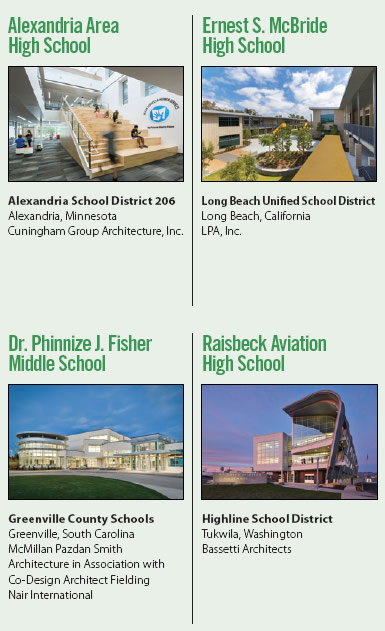
Alexandria Area High School demonstrates how a very engaged public process has resulted in an exceptional high school and the pride of the community. Designed as a “Community Center”, nearly every part of the school is activated by the greater community with business partners directly involved in educating the future workforce.
Ernest S. McBride High School, the first of several new thematic high schools in Long Beach, exceeded the district and community aspirations to address overcrowding while at the same time supporting the district’s most innovative programs. A comprehensive collaborative engagement process focused on college preparation and career readiness created an environment that encourages student independence relevant to their learning styles.
A new pedagogy based on an integrated, collaborative and project based learning curriculum informed this wonderful STEAM middle school project. Creative inquiry and project based learning can take place anywhere in Dr. Phinnize J Fisher’s flexible and adaptable learning spaces. The school conveys an atmosphere of a professional research facility with a balance of studio, collaboration and lab space.
Raisbeck Aviation High School provides a wonderful solution to a unique STEM program focusing on an aviation curriculum. A very strong vision and an exceptional public/private collaboration and partnership process provided the students with a stellar facility for inquiry-based discovery, exploratory learning and real world application.
The MacConnell award finalist projects will be showcased at the CEFPI LearningSCAPES Conference in San Diego, Calif., Oct. 22 to 26, 2015, where the winning project will be recognized.
This article originally appeared in the issue of .
About the Author
Barbara C. Worth is the director of strategic and private development at the Association for Learning Environments (A4LE), formerly the Council of Educational Facility Planners (CEFPI). A4LE is the only professional organization whose primary purpose is improving the places where children learn. With approximately 4,400 members, A4LE encompasses six geographic regions across the United States, and supports regional representation in Canada, Australasia, and the UK. To learn more, visit www.a4le.org or follow us on Twitter @A4LE2.