California State University, Long Beach
Project Snapshot
PROJECT:
Emergency Operations
Plan Enhancement
INSTITUTION:
California State University,
Long Beach
LOCATION:
Long Beach, CA
COMPANY NAME:
EVAC+CHAIR
North America, LLC
WEBSITE:
www.evac-chair.com
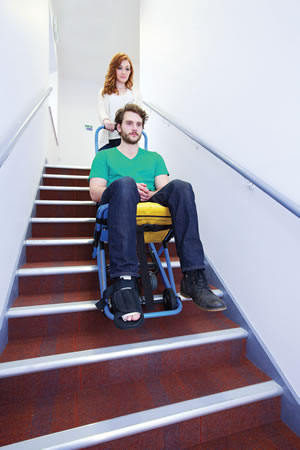
Ensuring student safety is one of the most important things a college or university
can do to create a great learning environment. CSULB was able to do just
that, by refining their EOP and adopting EVAC+CHAIR emergency evacuation
chairs on their campus.
THE CHALLENGE
At California State University Long
Beach (CSULB), university administrators
and officials recognized the
importance of having a long-term
Emergency Operations Plan (EOP)
in case of a disaster or emergency.
The university created an emergency
management advisory committee of
30 campus community members that
would review their EOP each quarter to
maximize preparedness.
One issue that was examined during
an examination of CSULB’s EOP was the
egress of those with limited mobility during
an emergency event. Having a way for
them to evacuate quickly and safely was a
problem that needed to be solved.
THE SOLUTION
The university and committee
explored several options, and chose
EVAC+CHAIR products because of their
ability to maneuver up and down stairs
while carrying a person weighing up to
350 pounds. “Our campus administration
was on board with the idea from the
beginning, which is why we were able to
approve funding for so many. We have
approximately 110 chairs, one on each
floor of every multi-level building with
the exception of parking structures,” explains
Allyson Joy, assistant emergency
coordinator at the university.
With a campus population of over
45,000, training for proper use of the
chairs was offered to police officers and
building marshals. The university now
offers training by request. “Everyone
knows what they are, they see them
every day, and at least acknowledge
it is a tool for emergency situations.
We focused first on training our police
officers and building marshals and then
made the training by request only.”
IMPACT ON LEARNING
Being completely prepared for an
emergency event means being sure that
every member of a campus community is
accounted for. CSULB has done just that,
by consistently reviewing their EOP and
by having EVAC+CHAIR products on campus.
Now, rather than faculty and staff
wondering what they might do for those
with limited mobility in an emergency,
they can focus on doing a job in a way
that benefits students the most.
In the same way, students of all
abilities can now focus on studying
and learning, knowing that they will
be able to evacuate quickly, if needed.
Creating a safe learning atmosphere
is one of the most important things a
college or university can do, and with
consistent EOP review and the right
evacuation products, CSULB is ensuring
safety for all community members will
be a priority for years to come.
Editor’s Review
The presence of safety
equipment informs a
campus population that
the facilities in which they
are spending their time are
safe, secure and meet the
necessary safety codes.
When building occupants
are confident that they can
evacuate efficiently in case
of an emergency, they can
focus on learning. Potential
students — and their parents
— also notice safety
features and equipment
when visiting potential
schools.
This article originally appeared in the issue of .