Northwestern University
Project Snapshot
PROJECT:
Sustainable Campus
Transportation
INSTITUTION:
Northwestern University
LOCATION:
Evanston, IL
COMPANY NAME:
Polaris GEM
WEBSITE:
GEMCar.com
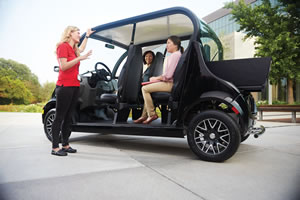
Polaris GEM electric vehicles help in the quest to keep facilities looking great and also serve as a sustainable feature on
campus that helps benefit students, faculty and staff with cleaner air.
THE CHALLENGE
There’s a transportation revolution taking place at
world-renowned Northwestern University in Evanston, IL. It
started in 2009 when Northwestern — in keeping with its
commitment to sustainability — challenged facilities leaders
to reduce greenhouse gas emissions 30 percent by 2030.
Northwestern’s facilities operations accepted and met
that challenge. And today, among the bustle of more than
20,000 students, they use a fleet of 10 Polaris GEM electric
vehicles to traverse the university’s 240-acres, quietly and
sustainably maintaining the pristine campus.
Northwestern’s commitment to sustainability spurred them
to look at replacing a number of gas-powered machines with
GEM vehicles beginning in 2015. After starting with a small fleet
of four, the university now is up to a fleet of 10. “Gas savings was
a contributing factor,” says Samantha Kustra, procurement analyst
at Northwestern University, “but decreasing greenhouse gas
emissions was the real reason for moving to electric vehicles.”
THE SOLUTION
The go-anywhere combination of street legal and
“off-road” capability was also key factors in Kustra’s choice to
go with GEM electric vehicles. The ability to drive on roads or
across turf and other terrain offers flexibility not found in golf
carts and other vehicle options.
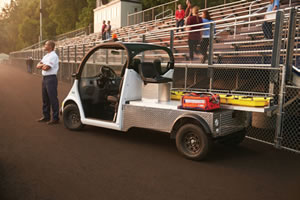 “When we initially started looking into electric utility
vehicles, two of the major requirements were that they be
street legal, but also that they could be driven on lawns,”
adds Kustra. “GEM gives us a zero-emissions, street-legal
vehicle that allows our staff to get anywhere on campus.”
“When we initially started looking into electric utility
vehicles, two of the major requirements were that they be
street legal, but also that they could be driven on lawns,”
adds Kustra. “GEM gives us a zero-emissions, street-legal
vehicle that allows our staff to get anywhere on campus.”
Bordering Lake Michigan north of Chicago, the climate
at Northwestern ranges from hot summer days to sub-zero
winter nights. Frequent travel across campus at all hours and
in any weather makes automobile-like features such as an
enclosed climate-controlled cabin, defrost, seat belts and
exterior lighting highly desirable.
“Our employees have had positive reactions to the power
steering, roomier cab and cargo space. It’s logical that the
more comfortable a driver is the safer the journey, too. GEM is
easy to get in and out of, and can carry all kinds of equipment
and people anywhere we need to go.”
IMPACT ON LEARNING
Northwestern’s GEM fleet was configured with
customizable utility and storage features to meet the
university’s unique needs. Students, faculty and staff are
benefitting from cleaner air and a well-maintained campus.
Polaris GEM is proud to be helping Northwestern run
leaner and greener.
Editor’s Review
A campus with hundreds
of acres of property and a
commitment to sustainability
— often cited by
students as a determining
factor in their selection of a
college or university — is
wise to invest in electric
vehicles for its maintenance
fleet. Savings are
realized, carbon emissions
are reduced, students
have a visual affirmation of
the institution’s commitment
to sustainability and
facilities staff have the
tools they need to maintain
a healthy campus for all.
This article originally appeared in the issue of .