Next-Generation Learning Spaces Prepare Students
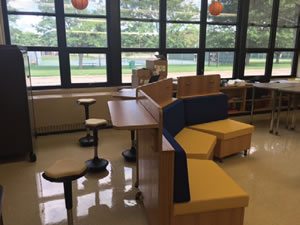
Creating a forward-thinking and flexible learning environment was made easier for Witchita Public Schools because of innovative designs from School Specialty.
Driven by the Wichita Public Schools District to create a forward-thinking, flexible and collaborative environment for 21st-century learning, our L’Ouverture Career Explorations and Technology Magnet School in Wichita, Kansas undertook a major classroom renovation project to outfit 18 classrooms (K-5) with innovative furniture and media technology solutions.
The initial project which began in May 2016 was done in partnership with education solutions provider, School Specialty (SSI) and its Projects by Design (PbD) team, to model two classrooms for the second and fifth grades. This encompassed installing flexible and mobile seating that would transform the traditionally fixed environment into an adaptable setting suited for various teaching and learning styles. The new furnishings were well-received by our faculty and students, and the district decided to expand the project to another sixteen K-5 classrooms and the library in 2017.
It is all about giving students the option to sit where it is most conducive for their learning, and this could only be possible with the right furniture and equipment.
Crucial to developing a 21st-century learning environment is the ability to support different teaching approaches. Our team worked with the School Specialty/Projects by Design crew to implement a combination of flexible, mobile and soft seating solutions from its Classroom Select line, including NeoMove and NeoRock furniture, as well as products from vendor partners such as Smith System, MiEN and Media Technologies. In particular, the Neo-Move and NeoRok seating help students to move gently (forward, backward or side-to-side), facilitating a calming effect and increasing their concentration and engagement.
www.schoolspecialty.com
This article originally appeared in the issue of .