Cleaning Made Easier with Cordless Backpack Vacuums
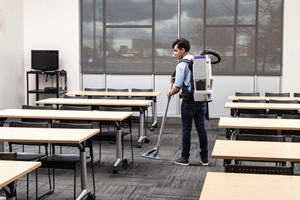
Protecting student health and the institution’s reputation was made easier for the University of Utah when they adopted the GoFree Flex Pro cordless vacuum in their cleaning operations.
The University of Utah’s campus in Salt Lake City is comprised of 130 buildings with 8.5 million square feet of facility space. The custodial staff of about 300 people maintains the campus through a district system with six groups that run somewhat independently of one another. Todd Stoneking works with a core group that supports the other six groups with equipment, training and other knowledge.
Motivated to protect the health of building occupants and enhance the respected image of the university, Stoneking and the rest of the custodial staff work to maintain the campus to a high standard in spite of challenging spaces. To improve cleaner productivity in challenging spaces, they implemented eight GoFree Flex Pro cordless backpack vacuums from ProTeam in six different buildings.
“Cordless backpack vacuums have their fit in cleaning a university, places where it is cost-effective to use them,” says Stoneking. “We can’t put one in every room, so we place them where they save enough time to save manpower in relation to the cost of the unit.”
The GoFree Flex Pro cleans in areas where power outlets are infrequent, where obstacles are prevalent, and where 24-hour traffic makes it difficult to clean safely. In each of those areas, it saves time. In the case of the campus library and lecture-style classrooms, it cut vacuuming time in half.
“We have another brand of cordless backpack vacuum as well,” says Stoneking. “After using them both a bit, my personal feeling is that the ProTeam is just a stronger vacuum with a better runtime.”
Stoneking improved upon the university’s cordless backpack vacuums by upgrading to the most recent harness design.
“The staff likes the new FlexFit harness a lot better than the previous harness,” says Stoneking. “It has better padding, so it’s a lot more comfortable.”
proteam.emerson.com
This article originally appeared in the issue of .