Boston Public Schools Unveils New STEM Early College Academy

The new $73 million Dearborn STEM 6-12 Early College Academy recently celebrated a ribbon cutting ceremony, and prepares to welcome students for the new school year. The Academy, the first new school construction project for Boston Public Schools in 15 years, is designed to support learning for computer science and engineering, health, and life sciences subjects.
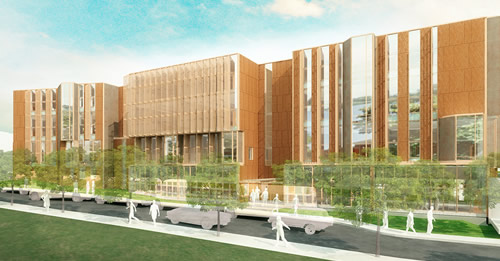
Dearborn STEM Academy

Dearborn features indoor and outdoor learning classrooms, two fabrication labs, a dance studio, 3D printers, and a large media center. The academy will initially serve 488 students, but is designed to accommodate 600 students by 2020. The Dearborn Academy took just over six years to plan, design, and build.

Featured

  • Geometric abstract school illustration

    How Design Shapes Learning and Success

    Can the color of a wall, the curve of a chair, or the hum of fluorescent lights really affect how a student learns? More schools are beginning to think so.

  • Miami University Approves New $242M Multipurpose Arena

    Miami University in Oxford, Ohio, recently announced that its Board of Trustees has approved construction of a new multipurpose arena at Cook Field, according to university news. The $242-million project will serve as a new centralized hub for student life and create space for economic development on campus.

  • University of Tennessee at Chattanooga Launches New Emergency Communications System

    The University of Tennessee at Chattanooga (UTC) recently deployed a new emergency notification and incident management system for its campus, according to a news release. The university partnered with 911Cellular to launch Safe@UTC, a smartphone app allowing university officials to communicate and respond during emergency situations.

  • Benson Polytechnic High School in Portland, OR

    Preserving Legacy, Designing for the Future

    As historic academic buildings age, institutions face a difficult decision: preserve and adapt or demolish and rebuild. How do we honor the legacy of these spaces while adapting them to meet the needs of modern learners?