New Floor Helps Keep Libraries Quiet
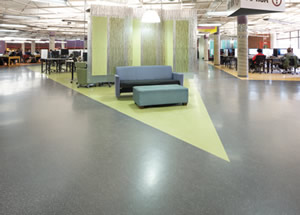
McMaster University was able to cut down on noise in learning environments by replacing their vinyl tile with nora rubber flooring.
Students at McMaster University in Hamilton, Ontario, Canada, can hear the difference rubber flooring makes. Thanks to the acoustic properties of norament grano, they enjoy quiet libraries and a better learning environment. Officials love the floor’s versatility, selecting it for heavily trafficked stairwells, laboratories, cafeterias, and offices.
“We love the versatility of the product—you can put it into a research facility, a wet lab where chemicals are present, a library, a cafeteria, an elevator or in an office,” says Craig MacDonald, director of maintenance and facility services. “It’s environmentally friendly, easy to care for, sustainable, and it provides good slip resistance.”
After testing nora premium rubber flooring in a heavily trafficked stairwell in one of the school’s busiest building, the university began using nora in other areas.
“There is a stairwell right by the road that receives most of the foot traffic into the building. The landings were previously VCT (vinyl tile) and didn’t stand up. The floor was hard to maintain; stripping and waxing was required. It was not effective,” MacDonald says. “We replaced it with full noraplan stair treads and tiles on the landings. Thousands of students walk up and down those staircases every day—and they still look fantastic.”
Since testing, the university has used nora in as many areas as possible. MacDonald says, “We’ve installed it in our student health services area and are currently using it in laboratory renovations. We’ve installed it in our three largest libraries.”
Ideal for the most demanding environments, norament grano has proven strength under pressure. It stands up to the toughest workplace conditions without sacrificing style, combining resilient form with supportive function in a palette of over 30 colors that range from cool, calming neutrals to bold, vibrant tones.
www.nora.com
This article originally appeared in the College Planning & Management October 2018 issue of Spaces4Learning.