College of the Atlantic Plans New $13M Academic Building

This spring, groundbreaking will take place on the campus of the College of the Atlantic in Bar Harbor, ME, on a new $13-million, energy-efficient Center for Human Ecology building that will house science laboratories, lecture halls, faculty offices, art and design studios, and a teaching greenhouse.
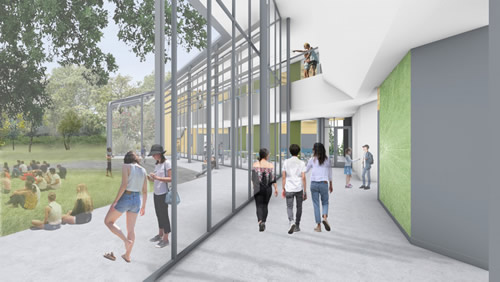
College of the Atlantic

The two-story, 29,000-square-foot building will be built to exacting energy standards, reducing energy usage by 80 percent compared to a similar building with more traditional construction designs and materials.

The architects for the project are Susan T. Rodriguez of New York City and GO Logic of Belfast, Maine. E.L. Shea, Inc. of Ellsworth is expected to lead construction of the building, which is expected to be completed by September 2020.

Featured

  • Geometric abstract school illustration

    How Design Shapes Learning and Success

    Can the color of a wall, the curve of a chair, or the hum of fluorescent lights really affect how a student learns? More schools are beginning to think so.

  • Beyond Four Walls

    Operable glass walls provide a dynamic solution for educational spaces. They align with today’s evolving teaching methods and adapt to the needs of modern learners. Beyond the functional versatility, movable glass walls offer clean, contemporary aesthetics, slim and unobtrusive profiles, and versatile configurations that cater to the evolving needs of students and educators alike.

  • UCNJ Launches $30M Modernization of Physical Education Center

    The Union College of Union County (UCNJ) in Cranford, N.J., recently broke ground on a new $30-million modernization project for its Physical Education Center (PECK), according to a news release. The college partnered with DIGroup Architecture for the project’s design, transitioning the existing 42,000-square-foot structure into a campus hub for student athletics and campus life.

  • Different Starting Points, Same End Goal

    Higher education campuses can enhance student experience by implementing mobile credentials to streamline building access, on-campus payments, and access to other amenities. This enables students to connect to their campuses through the technology they use most: their mobile devices.

Digital Edition