Virginia Commonwealth University College of Health Professions Opens

RICHMOND, VA – In 2019, to mark its 50th anniversary, Virginia Commonwealth University (VCU) has opened a new College of Health Professions building, designed by EYP Architecture & Engineering. Bringing all of the institution’s 11 units under one roof, from five different buildings across two campuses, will enable VCU students and faculty to collaborate in ways that have not been previously possible.
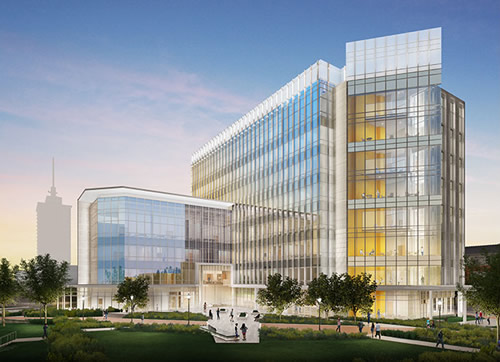
VCU Health Professions

Designed for LEED Silver certification, the $87.3 million College of Health Professions building will increase the capacity to grow VCU’s high-demand programs and promote a culture of interprofessional practice that mirrors the future of health care delivery.

The 154,000-square-foot building, which includes a west-facing eight-story wing and a south-facing four-story wing, is equipped with learning laboratories designed for patient simulation and diagnostic technology. Each of the eight floors features formal and informal spaces designed to promote interprofessional education and collaboration among the health professions specialties. Flexible classrooms have been designed for student engagement and distance-learning opportunities.

Featured

  • Colorado School District Breaks Ground on Unified PK–12 Campus

    The Haxtun School District No. Re-2J in Haxtun, Colo., recently announced that ground has been broken on a renovation/addition project that will unite its two schools, Haxtun Elementary and Haxtun Jr/Sr High School, according to a news release.

  • Deferred Maintenance Issues Growing at Universities, Gordian Reports

    U.S. colleges and universities are falling increasingly behind on facilities maintenance and repair, according to Gordian’s 13th annual State of Facilities in Higher Education report. The deferred capital renewal burden has reached $156 per gross square foot, an 8% increase over the previous year.

  • Universities Continue to Launch Multimillion-Dollar Campus Transformations

    What makes the current wave of campus development especially noteworthy is its emphasis on multi-use functionality and community integration. Institutions are no longer investing solely in academic or athletic facilities in isolation. Instead, they are creating destinations that blend recreation, health, housing, and event-driven economic activity.

  • Designing for Every Mind

    Learning environments have the power to shape not just what students know, but who they become. When a school is designed with genuine empathy—for the full range of ways students think, sense, and engage with the world—it becomes more than a building. It becomes a catalyst for growth, confidence, and belonging. That is the animating idea behind neurodiverse design, and it is one that is transforming how more architects and designers are thinking about school design.