A "Tinker Lab" for Young Students Opens in Pa. School

Germantown Academy, a PreK-12 private school in Fort Washington, Pennsylvania, recently gained a new makerspace aimed at younger students. In the makerspace, known as the “Tinker Lab,” PreK-5 students are able to problem solve through hands-on activities and be more engaged in learning.
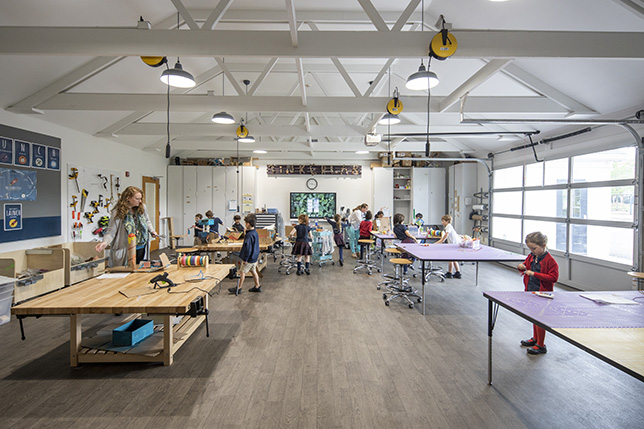
In the makerspace, known as the “Tinker Lab,” PreK-5 students are able to problem solve through hands-on activities and overall be more engaged in learning.

The Tinker Lab is equipped with a laser cutter, 3-D printer, workstations, an industrial sink, kitchenette and hand tools. The space used to be a PreK-2 grade space but as part of their improvements, the school decided to expand the space so that all students in the Lower School would be able to use it.

“All kids really love using their hands and making and building, so this space allows for that movement and that engagement to happen.” Jessica Killo, PreK-12 STEAM Coordinator, said in a video about the Tinker Lab.

The makerspace, designed by 1100 Architect, a New York-based design firm, includes a garage door for indoor-outdoor use and that allows natural light into the room.  
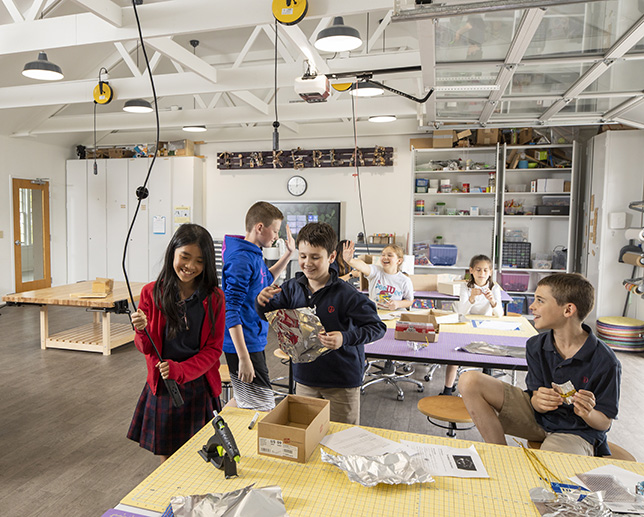
The Tinker Lab is equipped with a laser cutter, 3-D printer, workstations, an industrial sink, kitchenette and hand tools

In addition to the Tinker Lab, 1100 Architect renovated the Lower School’s entrance and parent gathering space, science classrooms and corridors. In 2016, the firm also upgraded a computer lab and part of the library into the Beard Center for Innovation, a makerspace and robotics lab.

“The new Tinker Lab provides something so important to young students — a place to be creative, to test ideas, to collaborate with peers, and to understand classroom lessons in tangible ways,” Gwen Conners, lead designer of the firm’s projects at Germantown Academy, said in a press release. “The Tinker Lab and the Beard Center for Innovation allow students of all ages a chance to engage in hands-on learning, and they help distinguish Germantown Academy as a leader of 21st century education.”

About the Author

Yvonne Marquez is senior editor of Spaces4Learning. She can be reached at [email protected].

Featured

  • TCU Marks Campus Expansion Milestone

    Texas Christian University in Fort Worth, Texas, recently held a topping-out ceremony to mark progress on a major campus expansion effort including four new residential facilities and a five-story parking garage, according to a news release.

  • Wold Completes Geothermal Projects at Two Minnesota Schools

    Wold Architects & Engineers recently announced that it has completed two geothermal expansion projects for Mounds View Public Schools in Shoreview, Minn., according to a news release. The work at Highview Middle School and Irondale High School serves the district’s long-term goal of reducing energy costs and dependency on non-renewable fuel sources, as well as improving building performance.

  • Designing for Every Mind

    Learning environments have the power to shape not just what students know, but who they become. When a school is designed with genuine empathy—for the full range of ways students think, sense, and engage with the world—it becomes more than a building. It becomes a catalyst for growth, confidence, and belonging. That is the animating idea behind neurodiverse design, and it is one that is transforming how more architects and designers are thinking about school design.

  • Year-Round Schools Require Year-Round Indoor Air Quality Planning

    While many schools are out for the summer, year-round schools follow a more “balanced” schedule with shorter, more frequent breaks spaced throughout the school year. Even though this offers educational benefits, these facilities have less downtime for building maintenance. This can become an issue when facilities managers overlook the importance of routine HVAC maintenance and air duct cleaning services.