New Academic Hub Planned for Drury University

SPRINGFIELD, MO – Drury University has announced Cooper Robertson as architect for its new Enterprise Center, a major academic building set to rise on the institution’s growing Springfield, MO, campus — and its first building project to be developed based on Cooper Robertson’s 2017 master plan.
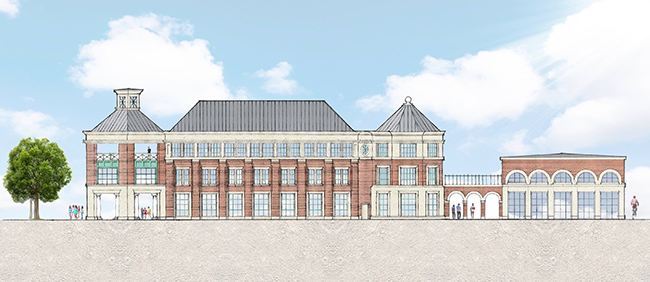
Drury University Academic Center

Rendering courtesy of Cooper Robertson

Designed in collaboration with Trivers Associates architects, the vision for the three-story, 54,772-square-foot Enterprise Center includes space for Drury's business and political science academic programs, as well as for high-tech student collaborative areas, facilities for guidance services and an executive conference center. According to Drury leaders, the project highlights an emphasis on entrepreneurship, innovation and interdisciplinary learning, and reflects the master plan’s recommendations for strategic moves that address the needs of today’s students in a rapidly changing world.

Other key features of the new building include an 11,000-square-foot Center for Executive Education attached by a colonnade to the main building. This conference center and flexible event space will be used extensively by the entire Drury campus as well as the greater Springfield community, reflecting the master plan’s goal of more tightly weaving Drury University into the fabric of its surrounding neighborhoods.

Groundbreaking is anticipated for spring 2020.

Featured

  • T&T Construction Management Group Completes Pasco High School Expansion

    Pasco High School in Dade City, Fla., recently announced that it has completed an expansion project in partnership with T&T Construction Management Group, Inc., Harvard Jolly Architecture, and Williams Company.

  • Preparing for the Next Era of Healthcare Education, Innovation

    Across the country, public universities and community colleges are accelerating investments in healthcare education facilities as part of a broader strategy to address workforce shortages, modernize outdated infrastructure, and expand clinical training capacity. These projects, which are often located at the center of campus health and science districts, are no longer limited to traditional classrooms.

  • Different Starting Points, Same End Goal

    Higher education campuses can enhance student experience by implementing mobile credentials to streamline building access, on-campus payments, and access to other amenities. This enables students to connect to their campuses through the technology they use most: their mobile devices.

  • Photo credit: Elkus Manfredi Architects

    University of Virginia Selects Design-Build Team for New Residential Complex

    The University of Virginia in Charlottesville, Va., recently announced that it has selected a design-build team for a new upper-class residential development on campus, according to a news release. Capstone Development Partners—in partnership with Elkus Manfredi Architects and the Hoar Construction/Hourigan construction team—will move forward with the three-building, 310,000-square-foot housing facility.