Makerbot Launches SKETCH Classroom
- By Yvonne Marquez
- 02/05/20
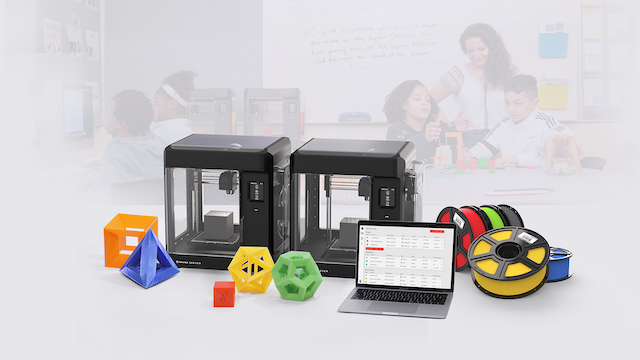
Makerbot, a 3D printer company and subsidiary of Stratasys, recently launched MakerBot SKETCH Classroom, a 3D printing setup for the classroom that maximizes student access and helps teachers manage printing resources and student projects.
More and more schools are implementing new technologies to develop students’ problem-solving and design thinking skills, like 3D printing. It can be challenging for teachers and students to learn how to use the 3D printer, integrate the technology into the curriculum and manage 3D printing resources in the classroom.
The SKETCH Classroom aims to address these challenges by offering a workflow solution that addresses the printer-to-student ratio challenge and provides a setup for effective printing. In addition, SKETCH Classroom includes certification courses for both teachers and students that trains them on how to operate the printer and includes curriculum in 3D printing, innovative design thinking, problem-solving and critical thinking skills.
“With SKETCH, we are changing the way 3D printing is used in schools and advancing the possibilities of learning to boost student innovation. We believe that SKETCH Classroom is the best 3D printing setup for the classroom, with an ideal student-to-printer ratio, making 3D printing more accessible to students, and setting educators up for 3D printing success,” Nadav Goshen, CEO of MakerBot, said in a statement.
The SKETCH Classroom includes two 3D printers with a fully-enclosed printing chamber, a heated and flexible build plate, a particulate filter, touchscreen capabilities, on-board camera, and Wi-Fi capabilities. The SKETCH firmware and print management software are connected to the MakerBot Cloud which includes a full suite of 3D printing applications. Students are able to submit their designs via MakerBot Cloud through their MakerBot account and teachers can manage, queue up and monitor students’ projects.
SKETCH Classroom is expected to begin shipping on Feb. 17. For more information about SKETCH Classroom, visit www.makerbot.com/sketch.
About the Author
Yvonne Marquez is senior editor of Spaces4Learning. She can be reached at [email protected].