"Welcome Center" Automates Health, Mask Check-in

A company that produces technology for the food industry has developed a "welcome center" that schools can use to automate student and staff check-in. The "AI Welcome Center" from PreciTaste uses artificial intelligence and computer "vision" to guide users through a touch-free check-in experience.
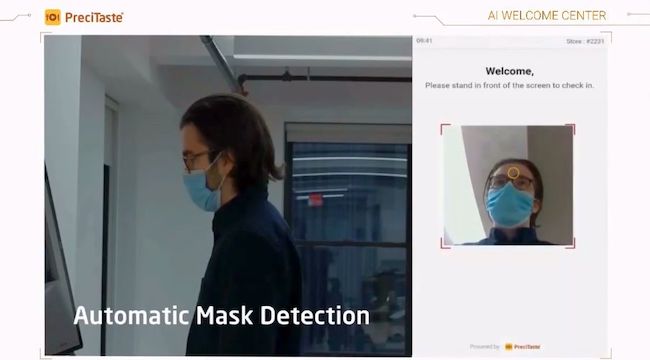
AI Welcome Center automatically turns on when a person faces it. Then it performs a quick temperature measure with laser-sensing technology and checks for face masks using "vision AI."

The system automatically turns on when a person faces it. Then it performs a quick temperature measure with laser-sensing technology and checks for face masks using "vision AI."

Students can have IDs scanned, and visitors can receive printed labels identifying that they have been scanned. According to the company, the check-in process takes under 15 seconds and the program retains no personally identifiable information. However, a contract tracing feature lets students opt-in to receive alerts in the event of a positive case, to assist the school in doing contact tracing.

The program provides for a voice-activated questionnaire to customize the set-up for a given state's regulations and recommendations.

A module for occupancy management is also available as an add-on feature.

About the Author

Dian Schaffhauser is a former senior contributing editor for 1105 Media's education publications THE Journal, Campus Technology and Spaces4Learning.

Featured

  • Utah Valley University Opens New Engineering Building

    Utah Valley University in Orem, Utah, recently held a grand-opening ceremony for the new Scott M. Smith Engineering Building, according to a news release. The facility is one of the largest engineering buildings in the state at almost 200,000 square feet, and it plays home to the university’s Smith College of Engineering and Technology (SCET).

  • Pitzer College

    Designing for Change in Higher Ed Learning Environments

    Higher education will continue to evolve, and learning environments must evolve with it. By prioritizing adaptable infrastructure, thoughtful reuse, strong energy performance, and wellness-centered design, campuses can create spaces that support learning today while remaining flexible for the future.

  • Colorado School District Breaks Ground on Unified PK–12 Campus

    The Haxtun School District No. Re-2J in Haxtun, Colo., recently announced that ground has been broken on a renovation/addition project that will unite its two schools, Haxtun Elementary and Haxtun Jr/Sr High School, according to a news release.

  • Philadelphia Middle School Facility Earns LEED Gold Certification

    The Alternative Middle Years (AMY) at James Martin Middle School in Philadelphia, Penn., recently received a LEED Gold certification from the U.S. Green Building Council, according to a news release. The School District of Pennsylvania partnered with KSS Architects on the project.