VS America to Discuss How Physical Spaces Impact Student Well-Being
VS America, a full-service manufacturer of school and office furniture, will host a webinar on Friday, March 19, discussing the opportunities and obstacles facing students as they return to school. The conversation will feature four panelists and focus on the impact of physical learning spaces on students’ mental and emotional well-being.
A survey of high-school students conducted by America’s Promise Alliance has revealed the various negative effects of COVID-19 in areas like social connection, emotional health, and learning time. Results show that 29% of students surveyed don’t feel connected to others, while 25% have difficulty sleeping due to negative emotions and 38% are concerned about their present and future education opportunities. The return to in-person learning, in other words, will entail much more than just catching up on the finer points of trigonometry.
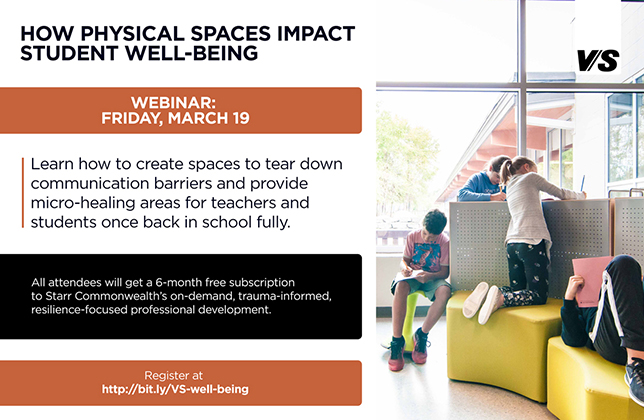
The webinar’s panelists include:
- Dr. RJ Webber, Assistant Superintendent of Curriculum and Instruction at Novi Community Schools in Novi, Mich.
- Dr. Caelan Soma, Chief Clinical Officer and Senior Trainer at Starr Commonwealth
- Jill Ackers, Learning Designer at Fielding International
- Roger B. Fisher, Associate Director of the Program on Intergroup Relations (IGR) at the University of Michigan
According to a press release, the webinar is slated to cover “how schools can create spaces to allow for the healing and connectivity needed.”
You can register here to attend. Attendees will also receive a free 6-month subscription to Starr Commonwealth’s “on-demand, trauma-informed, resilience-focused professional development.” The event will take place from 12:00–1:30 p.m. Eastern Time (9:00–10:30 a.m. Pacific Time) on Friday, March 19.
About the Author
Matt Jones is senior editor of Spaces4Learning. He can be reached at [email protected].