Diné College Breaks Ground on $7.4M Math and Science Building
Officials at Diné College’s Shiprock south campus in Shiprock, N.M., celebrated a groundbreaking ceremony this week for a new, $7.4 million Math and Science Building. The ceremony at the nation’s first tribal college began with a traditional Navajo blessing before Navajo leaders and members of the Board of Regents dug their shovels into the dirt. Planning for the new facility began in 2014, and construction is scheduled for completion by March 2022.
“The most important thank-you goes to the citizens of the State of New Mexico, because they are the ones that voted for this $5 million bond,” said Diné College President Charles “Monty” Roessel. “They are the ones who said this is important … This building is about $7.5 million … $2.5 million came from the creativity, ingenuity, and commitment of the Board of Regents. When something is that important, we find a way.”
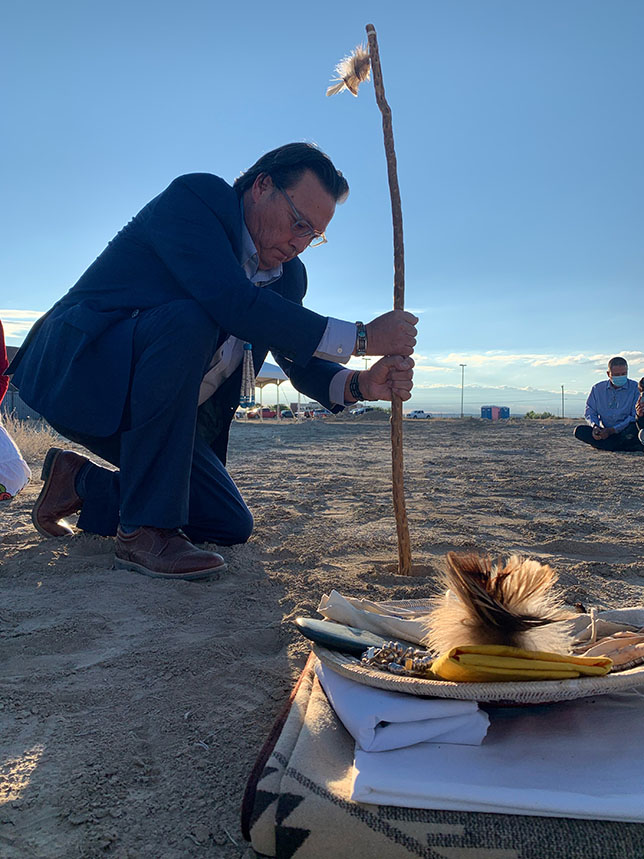
Diné College President Charles “Monty” Roessel, Ed.D, holds the Planting Stick. The Planting Stick is believed to be the original stick used when the Tsaile (AZ) main campus was built in 1971.
According to James Tutt, Dean of the School of STEM, 43 percent of the college’s graduates are from the School of STEM. “Current census data shows that the primary focus of jobs on the Navajo Nation are in the field of STEM,” he said.
The new facility measures in at 17,116 square feet and will house the college’s math and science departments as well as classrooms, laboratories, a student commons area, meeting rooms, offices, and more. Funding came from General Obligation Bonds that state voters approved in 2018 and from Capital Outlay funds from the State of New Mexico.
“On behalf of the Navajo people, I congratulate the Diné College Board of Regents, Diné College President Dr. Roessel, and the students who will benefit greatly from the new math and science center—and, in turn, this investment in our students will benefit our Nation for many years,” said Navajo Nation President Jonathan Nez. “This new facility will serve to develop and advance the minds of our young Navajo people who are striving for careers in the Science, Technology, Engineering, and Math (STEM) fields. Expertise in the STEM fields is a very critical part of building our Nation and improving the quality of life for our Navajo people. I commend Diné College for empowering our students and for growing our own here on the Navajo Nation.”
About the Author
Matt Jones is senior editor of Spaces4Learning. He can be reached at [email protected].