VMA Completes Baldwin School Innovation Center Adaptive Reuse Project

Voith and Mactavish Architects recently announced the completion of an adaptive reuse project at The Baldwin School in Bryn Mawr, Penn. According to a project narrative, the firm converted a poolhouse into an interdisciplinary and collaborative education center. The Baldwin School is an all-girls’ school for students PreK–12, and the narrative explains that one fundamental challenge of the project was to make the space safe and accessible for students of all ages.
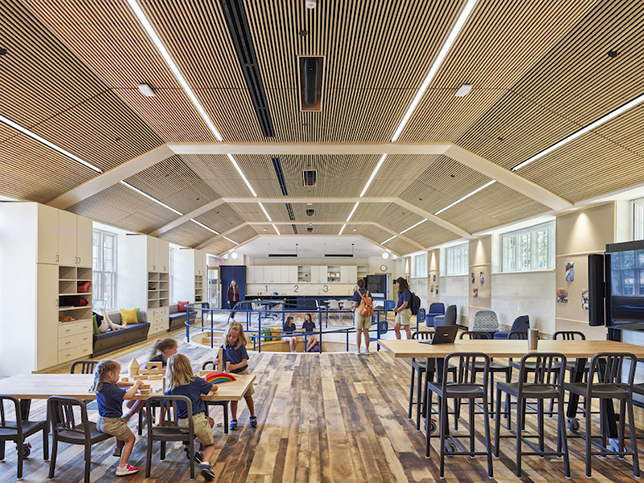
VMA Baldwin School Innovation Center
Image courtesy of Voith and Mactavish Architects

The original building covered roughly 3,500 square feet and served mainly as an open space with an excavated pool. The pool itself was converted into a sunken seating area accessible by steps or a ramp.

The purpose of the project was to create a new space where students can learn, make, and share. The space also offers flexible tables and seating to allow for an infinite array of easy reconfigurations. It includes storage, whiteboards, and display space at lower levels for younger students, as well as a makerspace with 3D printers and crafting tools for older students.

Finishes include neutral colors and materials like a wood flooring and ceiling to create a clean, orderly, dynamic space. The space features white surfaces with blue detail, combined with bright colorful cushions spaced throughout for a pop of color. The space also includes an adjacent courtyard patio accessible through French doors that visually connects the space with the rest of the campus and also filling the interior with natural light.

About the Author

Matt Jones is senior editor of Spaces4Learning. He can be reached at [email protected].

Featured

  • Designing for Every Mind

    Learning environments have the power to shape not just what students know, but who they become. When a school is designed with genuine empathy—for the full range of ways students think, sense, and engage with the world—it becomes more than a building. It becomes a catalyst for growth, confidence, and belonging. That is the animating idea behind neurodiverse design, and it is one that is transforming how more architects and designers are thinking about school design.

  • Surging Demand for Student Housing Fuels Major Campus Investment Opportunities

    University leaders throughout the U.S. are accelerating plans to modernize and expand student housing as enrollment stabilizes and demand for on-campus living rebounds. Recent data from the National Center for Education Statistics indicates that total postsecondary enrollment is projected to grow through the end of the decade, with undergraduate enrollment alone expected to increase by more than 8 percent by 2030.

  • Zurn Elkay Releases 2025 Sustainability Report

    Zurn Elkay Water Solutions recently announced the release of its annual sustainability report, according to a news release. The 2025 report discusses the organization’s efforts to maintain good environmental stewardship and the solutions provided in helping customers meet sustainability goals.

  • Universities Continue to Launch Multimillion-Dollar Campus Transformations

    What makes the current wave of campus development especially noteworthy is its emphasis on multi-use functionality and community integration. Institutions are no longer investing solely in academic or athletic facilities in isolation. Instead, they are creating destinations that blend recreation, health, housing, and event-driven economic activity.