IMETCO Launches New Line of Architectural Roof Panels

Metal product manufacturer IMETCO recently launched a new line of architectural metal roof panels, according to a news release. The Batten-Tile panels are designed for vertical walls or slopes of 3 inches or more, and they come in smooth or embossed surfaces in a wide variety of metals.
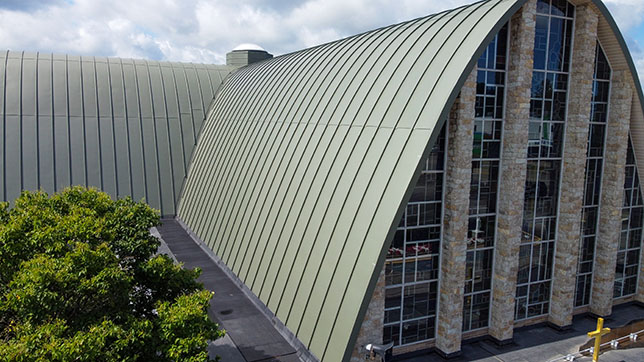

Photo courtesy of IMETCO

The batten-style ribs are 1.875 inches high and come in custom widths of up to 44.5 inches. Materials include aluminum, galvanized or stainless steel, copper, and zinc featuring either mill or fluoropolymer coatings. “With options such as conical tapers, convex, and concave curves and domes available, and panels as long as 45 feet, this versatile roofing panel is ideal for complex roofing projects with the highest aesthetic requirements,” said Jonnie Hasan, P.E., Director of Engineering and Sales Support for IMETCO.

The system meets ASTM E330 and ASTM E331 requirements, and it has been UL-tested and FBC approved, the news release reports. The roofing panels can be applied to plywood or gyp board with rigid insulation over decking. The news release does caution that installation requires appropriate IMETCO roofing underlayment per project-specific conditions.

About the Author

Matt Jones is senior editor of Spaces4Learning. He can be reached at [email protected].

Featured

  • Embry-Riddle Completes Construction on Research, Lab Facility

    Embry-Riddle Aeronautical University (ERAU) in Daytona Beach, Fla., recently announced the end of construction on a new research and lab facility on campus. The Center for Aerospace Engineering II (CAT II) will support aerospace research and technology development and broke ground last summer.

  • Designing the Bridge Between Inclusivity and Independence in K–12 Schools

    Fostering independence is fundamental to learning and development for K–12 students. It offers many proven benefits, such as enhanced confidence, problem-solving, decision-making, and social skills. However, this foundational objective loses its impact if it’s not accessible and adaptable to all students. Inclusivity plays a critical role in cultivating independence and healthy autonomy for students, fostering positive student learning outcomes by uniting pedagogy with the physical learning environment.

  • Year-Round Schools Require Year-Round Indoor Air Quality Planning

    While many schools are out for the summer, year-round schools follow a more “balanced” schedule with shorter, more frequent breaks spaced throughout the school year. Even though this offers educational benefits, these facilities have less downtime for building maintenance. This can become an issue when facilities managers overlook the importance of routine HVAC maintenance and air duct cleaning services.

  • Planning with Clarity: Using AI to Make Better Campus Decisions, Not Just Better Designs

    Higher education leaders are being asked to make increasingly high-stakes decisions about campus facilities amid greater uncertainty than ever before. Social and economic pressures, shifting enrollment, and evolving learning models compete with growing deferred maintenance needs to strain even the most robust infrastructure budgets.