Less Maintenance, Better Security, Insulation
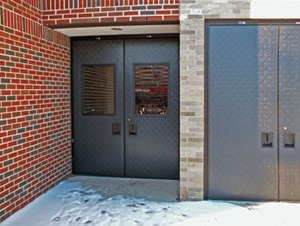
Special-Lite doors offered several benefits to the Union Grove School District, two of which were the saving of time and money.
As with most schools, maintenance and operating budgets at Union Grove School District, in Union Grove, WI. were spread pretty thin. Fortunately, Kurt Jorgensen, director of Operations & Facilities at Union Grove High School, found a way to save time and money, while at the same time improving security, by specifying Special-Lite FRP Doors.
The Union Grove district’s experience with SL-17 FRP Doors started with just one door, years ago. The hollow metal frame in that opening rusted away over time, but the door was still fine. Based on the performance of that door, Kurt convinced the school board to use Special-Lite FRP Doors instead of hollow metal doors, when all exterior doors were replaced in a renovation.
When Kurt learned that Special-Lite can locate proximity card readers inside an FRP door, protecting it from weather and tampering, he specified that option on nine of the new doors. As Kurt puts it, “that’s one less thing for kids to mess with.” Kurt also built in door position sensors so it is known whenever a door is opened, or has been propped open by a student.
After all exterior doors were replaced; Kurt says he could tell that the boilers were running less. On a cold December morning he noticed only one boiler was running, where before there would have been four running. According to Jorgenson, “I can tell by the temperature in the hallways, and teachers are saying that they are warmer. I’m turning down the temperature in their rooms. It is amazing.” Kurt attributes these changes to the replacement of the exterior doors with Special-Lite SL-17 FRP Doors.
When summing up his decision to insist on Special-Lite Doors, Kurt says, “I’m glad we did it. It’s one less headache. I know the doors are going to close every time.”
www.special-lite.com
This article originally appeared in the issue of .