Better Security Solutions for a Safer School
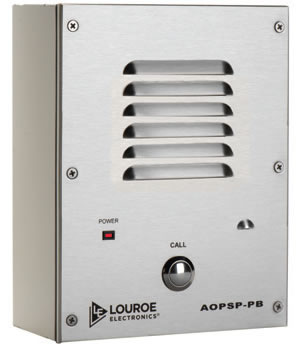
The AOP-SP-PB is a two-way audio intercom door station with push button control, and it provides an additional checkpoint for visitors.
An increased emphasis on the safety of students and staff has caused school systems around the United States to re-examine their security systems and protocols. Montgomery County Public Schools (MCPS), serving over 150,000 students, identified a serious need to better secure the main entrances of more than 120 elementary schools.
The school system turned to their longtime integrator, Netcom Technologies, Inc., for a recommendation. After looking at MCPS’ current security systems, Netcom discovered that some of the existing equipment could be leveraged and integrated with new technologies to create a cost-effective visitor control solution.
Specifically, Netcom utilized the existing Closed Circuit Television (CCTV) and Access Control Security (ACS) and maximized the IP megapixel camera’s monitoring ability by integrating it with Louroe Electronics’ AOP-SP-PB. The AOP-SP-PB is a two-way audio intercom door station with push button control, and it provides an additional checkpoint for visitors.
“The product works well and functions as intended,” says Tim Roberts, RCDD, RTPM, and account manager at Netcom. “Overall, the end user is very happy.”
With the new visitor control solution, MCPS has been able to proactively assess and manage everyone who enters and leaves the premise.
“I think the audio plays a very important role,” says MCPS Security Supervisor Douglas Steel. “It allows you to have an open dialogue with the visitor, verify the purpose for their visit and reduces the school’s liability.”
“The combination of audio and video allows us to have eyes and ears, and the ability to communicate with people on the ground,” explains Roberts. “The ability to monitor facial expressions and observe body language gives us greater insight into the subject looking to enter the building.”
With campus security as a top priority nationwide, there will likely be more schools that deploy audio to strengthen their security.
www.louroe.com
* There was a misprint of this case history in the June 2016 issue of SP&M. The content has since been updated and above you will find the corrected version.
This article originally appeared in the issue of .