Ceiling Designed for Learning
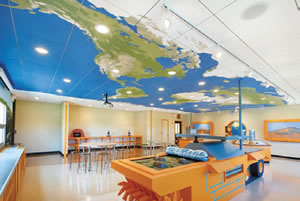
A map across the ceiling serves as an amazing learning
tool for students in the Springmill Learning Center’s new
Earth Studies Room.
The Springmill Learning
Center is a hands-on science
and outdoor education center
housed in a once-vacant elementary school.
During the design stages of the facility,
teachers decided each room in the new
Center should have a unique feature that
would both function as the focal point of
the space and support education.
To help attain the objective, the Mansfield
School District went to Splashmakers,
a firm experienced in the design of exhibits,
displays, and graphics for children’s spaces.
“Our goal was to create an educational environment
that was engaging, exciting, and on
budget,” states designer, Kevin Haring. “We
wanted to wow the students as they walked
in each room, while incorporating educational
elements throughout every part of the
room, including the ceiling.”
The Center’s new Earth Studies Room
features a large full color map of the world on
the ceiling. It was created using Ultima Create!
— a new custom design capability from
Armstrong that allows designers to fashion
their own one-of-a-kind ceiling art. The custom
ceiling art can be generated from either
digital artwork or imagery. For Springmill,
Haring took an existing photo of the earth,
vectorized it, and put it in an Adobe Illustrator
file. The file was then sent to Armstrong,
which transferred the image onto a series of
Ultima Vector acoustical ceiling panels.
And, the map is not the only teaching
tool in the ceiling. The suspension system in
which the ceiling panels are placed coordinates
with actual latitude and longitude
lines, while the recessed lights in the panels
can be turned on and off to highlight geographic
features like continents or oceans.
“We wanted to break the boundaries of what
people usually think a classroom should look
like,” Haring states. “We hope other school
systems will see this and get excited about
implementing environments like it.”
www.armstrongceilings.com
This article originally appeared in the issue of .