Team Cleaning Creates Consistency
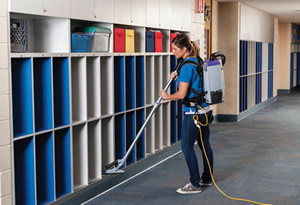
Aiken County Schools streamlined their cleaning process and created consistenct with help from ProTeam and a standardized Team Cleaning system.
Forty-two schools comprise Aiken County Public School District in South Carolina. Up until recently, every school approached cleaning tasks differently. Inconsistency in process, products, and training led to inconsistent cleanliness from building to building. So the county set out to make a change.
In pursuit of creating the best environment for students to learn and achieve, Aiken County Public Schools chose to implement a standardized cleaning system based on Team Cleaning with efficient ProTeam backpack vacuums. Blaine Riley, Education Program developer for Augusta Janitorial, has shepherded the transition. He helped blend the styles of Team Cleaning and zone cleaning to maximize efficiency for cleaners during the day.
In a K-12 setting, a cleaner must be present during the school day to clean as needed. In Aiken County’s hybrid system, those cleaners also tackle cleaning work by area type to stay as productive as possible. For example, an Aiken County day cleaner may clean offices or common areas in a zone concept. They would perform all cleaning tasks within that building, including vacuuming with an upright vacuum. The ProTeam ProForce 1500XP fits on the cart with all the other supplies and works best for Aiken’s zone cleaning approach.
At night, the staff bands together as teams of specialists. There are four types of specialists on a team, the vacuum specialist, the restroom specialist, the light duty specialist, and the utility specialist. They each use highly efficient tools and are expertly trained on a few tasks.
“We’re going to see a reduction in labor costs. But our goal is not to reduce staff. We just want a standardized and efficient approach to cleaning,” says Kip Gunter, the district’s director of Maintenance and Custodial. “This consistency will lead to cleaner and healthier environments for students, enabling them to both learn and achieve more.”
proteam.emerson.com
This article originally appeared in the issue of .