Houston Community College Breaks Ground on Culinary Arts Center
Houston Community College

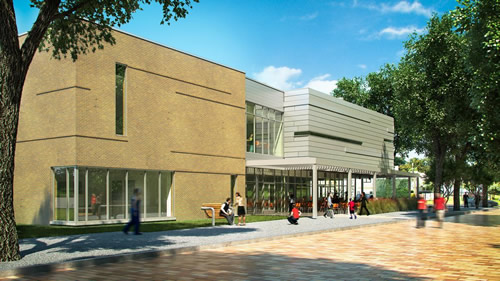
Houston Community College in Houston, TX, recently broke ground on its new Culinary Arts Center. The Center, which will be home to over 100 students each year, will contain labs for cooking and baking, a dining room, a bar, computer labs, and conference rooms with a reception area.

The new center will be two stories tall, and will be funded by a bond program approved by Houston voters in 2012. Construction on the new center is projected to take roughly two years.

Featured

  • St. John Fisher University

    Classroom Revitalization – Basil Hall Room 216

    Established in 1999, the Education Design Showcase is a vehicle for showing off innovative — yet practical — solutions in planning, design, architecture, and construction. St. John Fisher University's Basil Hall Room 216 Classroom Revitalization has been recognized with an EDS 2026 Project of Distinction award in the category of Spaces.

  • Minnesota District Opens New PreK–12 School

    Gibbon-Fairfax-Winthrop Schools in Gibbon, Minn., recently announced that construction is complete on a new, $68.9-million school for students in grades PreK–12, according to a news release.

  • Rethinking K-12 Schools as a Continuous Learning Experience

    Most students move through three or more separate facilities during their K-12 journey, yet the built environments they encounter at each stage have traditionally been designed in isolation, with little continuity in spatial language, learning philosophy, or physical resources. Each new school is a reset with different layouts, learning models, expectations, and ways of moving through a building. The next generation of school design is making the case that the first day of kindergarten and the last day of high school can and should feel connected through common support systems and infrastructure in the physical environment.

  • Higher Ed is Betting on New Buildings While Quietly Undermining Their Campuses — Here’s Why

    In this climate, the owner’s representative has changed from a delivery-focused advisor to a strategic campus partner. Institutions are increasingly relying on owner’s reps not just to manage, cope, schedule, and budget, but also help evaluate whether a project should proceed at all.