University of Wyoming Breaks Ground for Science Initiative Facility

The University of Wyoming (UW) in Laramie, WY, and state elected officials broke ground recently for a new facility that will enable world-class research and education in pillars of Wyoming’s present and future economy.
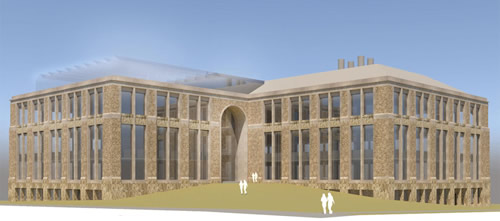
University of Wyoming

The Science Initiative facility will contain a 200-seat active-learning classroom, along with state-of-the-art research and laboratory space to support scientific imaging, biological, and greenhouse research. The initiative emphasizes collaboration among multiple disciplines by assembling researchers into a single complex with shared instrumentation, technical support and collaboration spaces.

Through life and data sciences research that impacts areas including mineral extraction, agriculture, tourism, resource management, and high technology, the Science Initiative will have direct economic impact through efficient translation of ideas to the marketplace. Combined with the Tier-1 Engineering Initiative, the Science Initiative’s multidisciplinary research will propel UW into national prominence as a center for economically driven, research-based education in science, engineering, technology and mathematics.

The $100 million project—$85 million from state appropriations, $15 million from UW reserves—is scheduled for completion in early 2021.

Featured

  • Nashville Elementary School Receives LEED Gold Certification

    Goodlettsville Elementary School, part of Metro Nashville Public Schools in Nashville, Tenn., recently achieved LEED Gold Certification from the U.S. Green Building Council (USGBC), according to a news release. The 81,750-square-foot school opened in 2023 and was designed by Goodwyn Mills Cawood (GMC).

  • Building Beyond Simulation: Creating Immersive Ecosystems for Healthcare Education

    Health sciences education is one of the fastest-growing facility types in colleges and universities. The demand for medical, nursing, and allied health professionals is driving the creation and renovation of medical simulation training facilities that provide students with real-world experience through advanced simulation-based learning.

  • Planning with Clarity: Using AI to Make Better Campus Decisions, Not Just Better Designs

    Higher education leaders are being asked to make increasingly high-stakes decisions about campus facilities amid greater uncertainty than ever before. Social and economic pressures, shifting enrollment, and evolving learning models compete with growing deferred maintenance needs to strain even the most robust infrastructure budgets.

  • University of Pennsylvania Releases Design of Future Physical Sciences Building

    The University of Pennsylvania (Penn) in Philadelphia, Penn., recently released renderings of an upcoming 350,000-square-foot Physical Sciences Building, according to news release. The facility was designed by CO Architects and will unite the university’s departments of Physics and Astronomy, Mathematics, and Earth and Environmental Science.