University of Florida Breaks Ground for New Baseball Stadium

The University of Florida held a groundbreaking ceremony this month for a new baseball stadium, set to host the Gators in 2021. The new park will cost $65 million and expects to be completed in June of 2020.
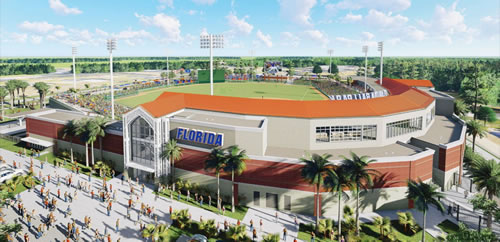
Florida Baseball Stadium

The park will feature a 360-degree open concourse with added shade around the park. The permanent seating will change from 2,400 to more than 4,000. Grass berms and other non-traditional seating will also be available, which the university hopes will help create a more social atmosphere.

The new park will be located on the southwest corner of campus, while the current stadium will be turned into a football training center.

Featured

  • UNT Dallas Holds Ribbon-Cutting Ceremony for $100M STEM Building

    The University of North Texas at Dallas in Dallas, Texas, recently celebrated the opening of its new, $100-million STEM Building, according to local news. The ceremony on Dec. 2 preceded the first day of classes in the facility on Jan. 12, 2026.

  • UCNJ Launches $30M Modernization of Physical Education Center

    The Union College of Union County (UCNJ) in Cranford, N.J., recently broke ground on a new $30-million modernization project for its Physical Education Center (PECK), according to a news release. The college partnered with DIGroup Architecture for the project’s design, transitioning the existing 42,000-square-foot structure into a campus hub for student athletics and campus life.

  • South Texas K–12 District Debuts Region’s First Electric Bus Fleet

    The Valley View Independent School District in Pharr, Texas, recently announced a partnership with Highland Electric Fleets to launch the district’s—and the region’s—first fleet of all-electric school buses, according to a news release.

  • Preparing for the Next Era of Healthcare Education, Innovation

    Across the country, public universities and community colleges are accelerating investments in healthcare education facilities as part of a broader strategy to address workforce shortages, modernize outdated infrastructure, and expand clinical training capacity. These projects, which are often located at the center of campus health and science districts, are no longer limited to traditional classrooms.

Digital Edition