New Academic Hub Planned for Drury University

SPRINGFIELD, MO – Drury University has announced Cooper Robertson as architect for its new Enterprise Center, a major academic building set to rise on the institution’s growing Springfield, MO, campus — and its first building project to be developed based on Cooper Robertson’s 2017 master plan.
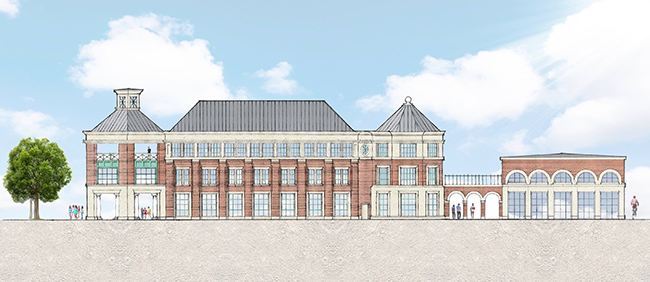
Drury University Academic Center

Rendering courtesy of Cooper Robertson

Designed in collaboration with Trivers Associates architects, the vision for the three-story, 54,772-square-foot Enterprise Center includes space for Drury's business and political science academic programs, as well as for high-tech student collaborative areas, facilities for guidance services and an executive conference center. According to Drury leaders, the project highlights an emphasis on entrepreneurship, innovation and interdisciplinary learning, and reflects the master plan’s recommendations for strategic moves that address the needs of today’s students in a rapidly changing world.

Other key features of the new building include an 11,000-square-foot Center for Executive Education attached by a colonnade to the main building. This conference center and flexible event space will be used extensively by the entire Drury campus as well as the greater Springfield community, reflecting the master plan’s goal of more tightly weaving Drury University into the fabric of its surrounding neighborhoods.

Groundbreaking is anticipated for spring 2020.

Featured

  • Florida District Completes Construction on New Leadership Institute

    Pinellas County Schools near Tampa, Fla., recently announced that construction is complete on the new Dr. Michael A. Grego Leadership Institute, according to a news release. The district partnered with Rowe Architects for the project’s design and with Skanska for construction services.

  • Designing for Every Mind

    Learning environments have the power to shape not just what students know, but who they become. When a school is designed with genuine empathy—for the full range of ways students think, sense, and engage with the world—it becomes more than a building. It becomes a catalyst for growth, confidence, and belonging. That is the animating idea behind neurodiverse design, and it is one that is transforming how more architects and designers are thinking about school design.

  • Architectural Power for the Modern Campus Landscape

    For generations, an outdoor classroom only required a textbook and a patch of grass. Today, not only has the laptop replaced the printed pages, the rise of agile learning has turned campuses into study halls with students listening to lectures and researching topics from quads, gardens, and plazas. The challenge for architects and facility managers is to provide connectivity without cluttering the landscape with visual eyesores or creating safety hazards with extension cords.

  • Moline-Coal Valley School District to Consolidate Two Schools into New Facility

    The Moline-Coal Valley School District in Moline, Ill., recently broke ground on a new elementary school that will consolidate the students and staff from two existing schools, according to local news. Robert Ontiveros Elementary School will serve as the new home for Lincoln-Irving Elementary School and Willard Elementary School.