New Fairfield Schools Select JCJ Architecture for New Projects

New Fairfield Schools Select JCJ Architecture for New Projects

New Fairfield Public Schools recently selected JCJ Architecture to design two new school projects — the expansion of the Grades 3 through 5 Meeting House Hill School and a new high school.
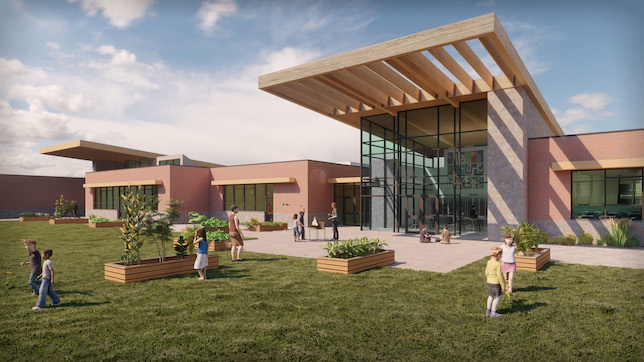
New Fairfield Public Schools recently selected JCJ Architecture to design two new school projects — the expansion of the Grades 3 through 5 Meeting House Hill School and a new high school.

Elementary Exterior

Voters in New Fairfield, Connecticut approved the $113 million school building plan in 2019. About $84 million is needed for the new high school, while $29 million will go to the new addition at Meeting House Hill School. The new 44,000-square-foot addition will accommodate the Consolidated Early Learning Academy (CELA) for PreK-1, while the existing facility will be converted to serve Grades 2 through 5. The high school is planned to be 143,000 square feet.
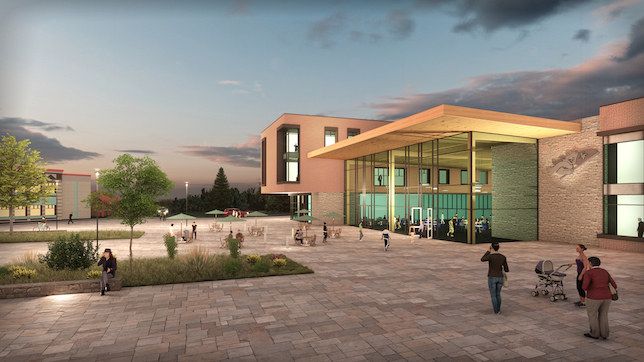
New Fairfield Public Schools recently selected JCJ Architecture to design two new school projects — the expansion of the Grades 3 through 5 Meeting House Hill School and a new high school.

High School Exterior

JCJ Architecture proposed schemes for the new construction to the town’s Permanent Building Committee which the firm says — “focused on ways to maximize use of the site, addressed vehicular circulation, incorporated sustainable principles, created community and collaboration-oriented spaces, and organized programs to maximize building and educational efficiency.”

JCJ Architecture will work with project management firm Colliers International to move the project through the planning and design process. The project is scheduled to break ground in Spring 2021 with CELA slated for completion in 2022 and the new high school in 2023.

About the Author

Yvonne Marquez is senior editor of Spaces4Learning. She can be reached at [email protected].

Featured

  • Building Beyond Simulation: Creating Immersive Ecosystems for Healthcare Education

    Health sciences education is one of the fastest-growing facility types in colleges and universities. The demand for medical, nursing, and allied health professionals is driving the creation and renovation of medical simulation training facilities that provide students with real-world experience through advanced simulation-based learning.

  • Q&A: How to Prevent Kitchen Grease Fires in Commercial Kitchens

    School cafeterias and university dining halls serve thousands of meals daily, relying on high-heat equipment like fryers, grills, and ovens. While these operations keep students fed, they also generate significant grease-laden vapors. Without proper controls, this grease becomes a silent fire threat. As a certified exhaust cleaning specialist and business coach who has helped hundreds of institutional facilities achieve NFPA 96 compliance, I emphasize that proactive grease management isn’t optional; it’s a core fire/life safety practice.

  • Washington State University Debuts New Engineering Hall

    Washington State University recently celebrated a dedication ceremony for the new Schweitzer Engineering Hall on its Pullman campus in Pullman, Wash., according to university news. The facility measures 66,288 square feet, and its completion marks the first milestone in a larger university effort to modernize the engineering and design district.

  • Back-to-School Playground Safety: 7 Common Hazards to Look for After Summer Break

    As summer break comes to an end, school administrators have plenty to prepare before students return. While classrooms, hallways and common areas often receive attention during all the back-to-school preparations, the playground should not be overlooked. Months of weather exposure, storms, and regular wear can leave behind hazards that may not be immediately noticeable.