Leviton Lighting Announces Product Line Expansion
Leviton Lighting, a lighting and wireless control solutions company, recently released a series of announcements regarding new and existing products.
First, it will be expanding its Smart Wallbox Sensors line to include a new, 1000W dimming model for phase cut applications; multi-way capabilities for as many as five devices on all its existing models; and a non-neutral switching model. All solutions are designed for out-of-the-box implementation with minimal contact and simple installation. New products include the Smart PIR 1000W Dimming Wallbox Sensor (ODP10-I1x) and Smart PIR Wall Switch Wallbox Sensor (ODS15-GDx). All products are designed to accurately detect minimal motion within 400 square feet and major motion within 1,100 square feet.
“Leviton’s expanded Smart Wallbox Sensor line delivers increased functionality and ease of use,” said Tom Leonard, Leviton’s vice president of controls. “These sensors do so much, so easily, they are the ideal go-to choice for commercial occupancy and vacancy sensing needs. Whether phase dimming or 0–10, switching for new or retrofit, this line has it covered.”
Second, it announced the release of the new Zigbee 3.0 Controlled Receptacle, which provides wireless plug load control and meets IECC; ASHRAE 90.1; and 2019 Title 24, Part 6 code compliance. The Zigbee Controlled Receptacle is compatible with Leviton Wireless Room Controllers and third-party Zigbee 3.0 compatible hubs, gateways and controllers to provide wireless on/off plug load control. The device can be used with lamps, appliances and other devices up to 15A in wireless applications that require receptacle control or plug load control to meet energy code compliance.
“The Zigbee 3.0 Controlled Receptacle delivers an exciting addition to our commercial wireless lighting control line,” said Leonard. “It eliminates the pain point of pulling new wires to meet IECC; ASHRAE 90.1; and 2019 Title 24, Part 6 energy code requirements for receptacle control or plug load control. Users can easily install the Receptacle in place of traditional wall receptacles and use the app to complete configuration.”
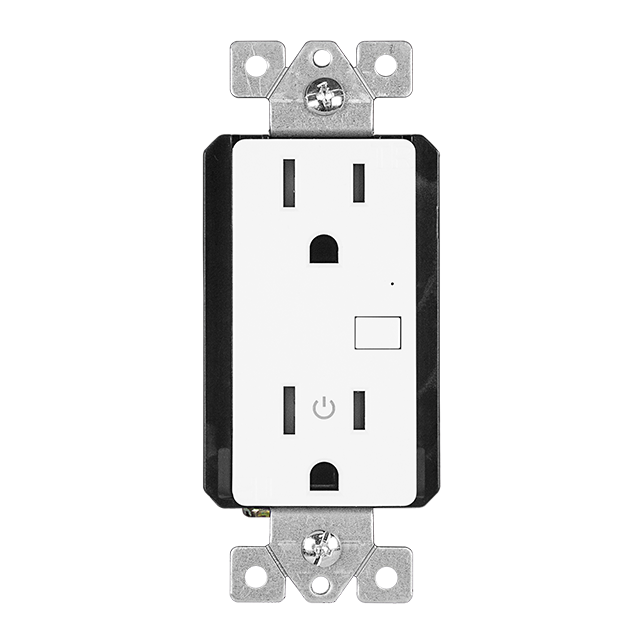
Zigbee 3.0 Controlled Receptacle
Finally, two ConTech Lighting by Leviton products—the ConTech Track System and Mini Stealth Track Luminaire—became the first track lighting products in the industry to earn published Declare Labels for use with Living Building Challenge products. According to a news release, a Declare Label offers information about where a product comes from, what it’s made of and where it goes at the end of its life. Declare is a transparency platform and product database program designed by the International Living Future Institute (IFLI).
“We are excited to earn the first track lighting Declare Labels for two of ConTech’s top track products, with more to come. It is critically important that we partner with programs focused on a future of healthier buildings and work environments like the Living Building Challenge,” said Michael Lehman, general manager of ConTech Lighting. “Participating in IFLI’s Declare Program is key to ensuring product transparency for lighting specifiers and that our customers get the best products as we all work together for a more sustainable and healthy future.”
About the Author
Matt Jones is senior editor of Spaces4Learning. He can be reached at [email protected].