Riverside Community College District Completes $29.3M Renovation Project

Riverside City College recently announced the completion of a $29.3-million renovation project, according to a news release. The college partnered with Nineteen Six Architects and builder C.W. Driver Companies to convert a 1960s-era academic building into a new Business, Law, and Computer Information Systems Building. The project created 34,055 square feet of new learning space and took about 18 months to complete.
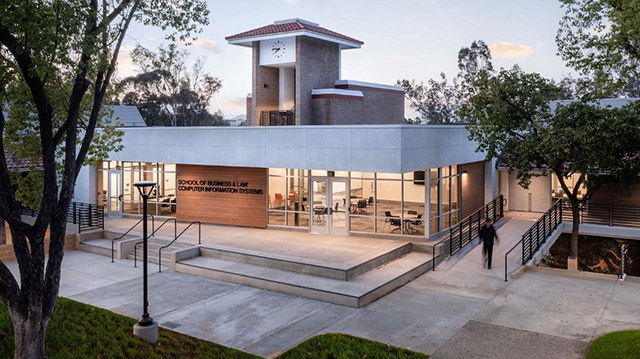

Ohoto courtesy of C.W. Driver Companies

Work involved demolishing all interior spaces to create new classrooms, conference rooms, testing centers, computer labs, and a multipurpose room, the news release reports. The site formerly consisted of a two-story classroom building and four-story service tower. The retrofit united the two structures via an addition on the upper level that also made space for a lobby and main entry, circulation spaces, meeting rooms, and open study spaces.

“This is our second project with the Riverside Community College District in the last couple of years. Previously we worked on the Ben Clark Public Safety Training Center at Moreno Valley College,” said Dave Amundson, C.W. Driver Companies Project Executive. “It’s another example of a repeat client that we work to grow a long-term relationship with us through new projects.”

The addition’s lower level features storefronts that provide additional interior access between the two buildings. Further new amenities include courtroom lecture space, a Cyber Security Lab, a Network Operation Center, and space for computer servers. The project was also designed according to LEED Gold Certification, the news release reports.

About the Author

Matt Jones is senior editor of Spaces4Learning. He can be reached at [email protected].

Featured

  • Building Beyond Simulation: Creating Immersive Ecosystems for Healthcare Education

    Health sciences education is one of the fastest-growing facility types in colleges and universities. The demand for medical, nursing, and allied health professionals is driving the creation and renovation of medical simulation training facilities that provide students with real-world experience through advanced simulation-based learning.

  • Q&A: How to Prevent Kitchen Grease Fires in Commercial Kitchens

    School cafeterias and university dining halls serve thousands of meals daily, relying on high-heat equipment like fryers, grills, and ovens. While these operations keep students fed, they also generate significant grease-laden vapors. Without proper controls, this grease becomes a silent fire threat. As a certified exhaust cleaning specialist and business coach who has helped hundreds of institutional facilities achieve NFPA 96 compliance, I emphasize that proactive grease management isn’t optional; it’s a core fire/life safety practice.

  • Washington State University Debuts New Engineering Hall

    Washington State University recently celebrated a dedication ceremony for the new Schweitzer Engineering Hall on its Pullman campus in Pullman, Wash., according to university news. The facility measures 66,288 square feet, and its completion marks the first milestone in a larger university effort to modernize the engineering and design district.

  • Back-to-School Playground Safety: 7 Common Hazards to Look for After Summer Break

    As summer break comes to an end, school administrators have plenty to prepare before students return. While classrooms, hallways and common areas often receive attention during all the back-to-school preparations, the playground should not be overlooked. Months of weather exposure, storms, and regular wear can leave behind hazards that may not be immediately noticeable.