Enhances School Interior
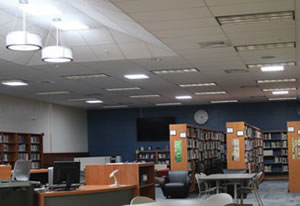
Solatube helped bring daylight to the Newington High School library during a major renovation.
Until recently, Newington High School in Newington, CT, hadn’t been updated for 40 years. Its media center, centrally located within the building and surrounded by corridors and classrooms, had no openings facing the exterior and, thus, no daylight.
Enter Solatube International, Inc. and the company’s “Operation Textbook” program, which provides tubular daylighting devices (TDDs) to Pre K-12 school districts and higher education institutions interested in adding daylight to their facilities.
Architect Kevin Lipe, AIA, LEED-AP, with Jacunski Humes Architects, knew that Newington High School was a perfect fit for the program. Working closely with Willco Sales& Service, the Solatube commercial distributor for New England, they installed a number of Solatube SolaMaster 750 DS-C units to bring daylight into the school’s darkest spaces.
“Since the media center was one story, penetrations from the roof yielded immediate openings into the space below and made the decision to use Solatube Daylighting Systems quite simple,” Lipe says.
Once ceiling grids and electrical lighting (for night hours) were worked out, the units were positioned for the greatest dispersion of natural light throughout the room. Diffusers laid into the grid gave units the same appearance as recessed fluorescents. Units were also clustered in gathering areas, such as the circulation department and quiet reading areas.
“I was impressed with the difference natural daylight brought to the room. Before the project, turning off the room lights left most of the space in darkness and brought to a stop whatever activities were underway. Now, turning off the lights causes an almost imperceptible change to light levels and activities continue on uninterrupted,” Lipe says. “Solatube Daylighting Systems greatly enhance the quality of ambient light throughout the space without shadows, glare or direct sun.”
This article originally appeared in the issue of .