Endicott College
Curtis L. Gerrish School of Business and Ginger Judge Science Center
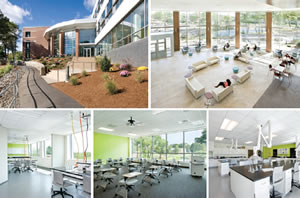
PHOTOS © SHELLY HARRISON PHOTOGRAPHY
When the deans of the business and science departments at Endicott College in Beverly, MA, wanted to develop stronger connections between the two divisions, school leadership — recognizing the value of interdisciplinary collaboration — took them seriously. So seriously that they commissioned a new building on the campus: the Curtis L. Gerrish School of Business and Ginger Judge Science Center.
Designed by Tsoi/Kobus & Associates of Cambridge, MA, and built by Windover Construction of Manchester-by-the-Sea, MA, the new building places state-of-the-art business classrooms and leading-edge, flexibly designed laboratory spaces under one roof, united through collaborative spaces that facilitate both impromptu connections and cooperative academic programming. On the entry level, the Angle Center for Entrepreneurship promotes business and science, establishing partnerships and opportunities for students with business and science leaders, entrepreneurs and experts.
Drawing upon lessons from Tsoi/Kobus’s extensive life science and higher education design portfolios, laboratory teaching spaces in the Judge Science Center wing are modeled on professional laboratory design trends, where flexibility is a mandate.
The labs, with the exception of the chemistry lab, feature adaptable workstations that can be reconfigured and are moveable and adjustable in height to accommodate a number of research and study activities. All service and utility drops to the tables (vacuum, data, power and compressed air) are housed in the ceilings and can be easily relocated depending on the configuration needs of the room. Walls are covered with whiteboard paint for teaching and impromptu problem solving. Each lab is equipped with at least one variable-air-volume hood to accommodate and anticipate a changing curriculum. In addition, operable classroom walls allow rooms to be resized as needed.
Today the Gerrish School of Business and Judge Science Center is the centerpiece of the Endicott campus, illustrating the college’s mission of attracting leading research talent, providing students with valuable real-world experience and understanding of the business of science.
This article originally appeared in the issue of .