Acoustic Panels Reduce Noise and Boost Productivity
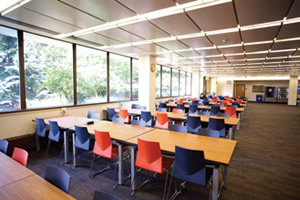
Acoustic Lay-in Panels from Eckel Noise Control Technologies helped Adelphi University give its students a quiet space for study that supports both individual and collaborative efforts.
On higher education campuses and in other academic settings, the library is a destination for group study and project collaboration. These endeavors require students to interact verbally. But when the environment isn’t acoustically designed for that purpose, things get noisy, and both those in groups and those doing individual study suffer.
This is exactly the situation that Long Island’s Adelphi University found itself in about five years ago. Ceiling tiles in the collaborative study area on the first floor of the Swirbul Library were old and had been painted several times over. This destroyed any absorptive qualities the tiles once had and actually made them reflect and reverberate sound.
“The collaborative study area was very loud, so much so that students had to raise their voices as if they were outside,” says Jerry Tangredi, Adelphi’s associate director for Facilities Planning, Construction and Design.
Tangredi reached out to an acoustics consultant he had known and worked with for several years. Sy Lerner, vice president at Controlled Acoustics Corporation, visited the library to assess the situation. He proposed installing Acoustic Lay-in Panels (ALPs) from Eckel Noise Control Technologies of Cambridge, MA.
For the initial Adelphi project, Eckel manufactured 20 custom-sized ALPs to accommodate the existing drop-ceiling grid in the collaborative study area. In the months following the installation, both staff and students noted a marked improvement.
“We now have ALPs in all areas of the library where students work together,” Tangredi says. “Our students and staff are very pleased with the outcome. It’s gratifying to have found a solution that enables effective collaborative work without the risk of creating a disturbance that impedes anyone else’s studies.”
With a total of more than 2,400 Eckel ALPs installed in the library, Adelphi students now enjoy the benefits of a quiet space for both collaborative and individual research and study.
www.eckelusa.com
This article originally appeared in the issue of .