Team Cleaning with Effective Tools
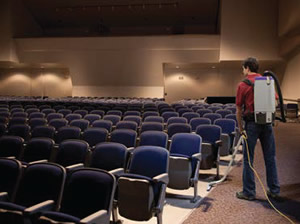
ProTeam helped WMU achieve better environmental
quality with the Super Coach Pro vacuum, which removes
microscopic dust and pollutants from the air.
Western Michigan University (WMU) opened
its doors over 100 years
ago. Today, its facilities house about
24,000 students from all over the world
who are all there to pursue greater knowledge.
For Steven Gilsdorf, director of
building custodial and support services,
removing unwanted matter like dirt,
particulate and allergens from university
facilities is key to fostering learning.
“We are cleaning for health and safety,
not just appearance,” says Gilsdorf. “The
key to that is removing matter.”
In order to become removers of
unwanted matter, Gilsdorf and his team
implemented a customized version of Team
Cleaning they call Process Cleaning. Like
a Team Cleaning program, Western Michigan
custodial uses specialists who take on
fewer tasks with state-of-the-art equipment
to improve efficiency and clean to a
higher standard. A typical Team Cleaning
program has four specialists; WMU added
three more specialists to fit the specific
needs of their facilities.
At WMU, the standard restroom specialist,
vacuum specialist, light duty specialist
and utility specialist work in tandem with
a light bulb specialist, a project specialist
and a refresher specialist. This specialist
“refreshes” restrooms and common areas,
empties trash and addresses spills.
“Overall, we have seen cleaner buildings,
because our method of cleaning removes
more,” said Gilsdorf. “We maintain an APPA
level of a high two, and we do not see the
levels of illness and absenteeism that other
schools and universities near us have had.”
In the last two years, Gilsdorf also
expanded the use of ProTeam backpack vacuums
to all departments of the school. With
an advanced filtration system, the Super
Coach Pro model backpack captures microscopic
dust and pollutants, helping to further
the goal of removing unwanted matter.
“Before ProTeam backpack vacuums,
we were dusting lobbies and common areas
daily,” says Gilsdorf. “The backpack vacuums
made a huge difference. The environmental
quality is so much better. We are
now dusting those areas once a week.”
www.proteamnextgen.com
This article originally appeared in the College Planning & Management September 2016 issue of Spaces4Learning.