O&G Breaks Ground at Grasso Technical High School
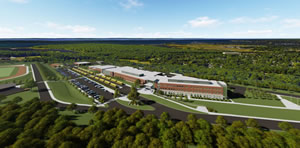
Grasso Tech High SchoolO&G Industries, Connecticut’s largest privately-held construction company, began work on the construction of the new Ella T. Grasso Technical High School in Groton, Connecticut.

O&G was selected as the Construction Manager for the $98.3 million dollar construction project. The project will include construction of a new 220,000 square foot facility on the existing site.  The new school will be built adjacent to the current facility with completion of the new building expected in the fall of 2019 for arriving students, followed by demolition of the existing school where new athletic facilities will be sited on its former footprint. 

Grasso serves students from 24 towns in Southeastern Connecticut with an annual enrollment of over 500 students.  Programs offered at the school include Automotive Technology, Culiary Arts, Electrical, Manufacturing Technology, Plumbing & Heating, HVAC and Information Systems Technology.   The new facility will allow the school to serve 800 students from throughout the region, offering eleven programs in technology and core programs.

Featured

  • Embry-Riddle Completes Construction on Research, Lab Facility

    Embry-Riddle Aeronautical University (ERAU) in Daytona Beach, Fla., recently announced the end of construction on a new research and lab facility on campus. The Center for Aerospace Engineering II (CAT II) will support aerospace research and technology development and broke ground last summer.

  • Designing the Bridge Between Inclusivity and Independence in K–12 Schools

    Fostering independence is fundamental to learning and development for K–12 students. It offers many proven benefits, such as enhanced confidence, problem-solving, decision-making, and social skills. However, this foundational objective loses its impact if it’s not accessible and adaptable to all students. Inclusivity plays a critical role in cultivating independence and healthy autonomy for students, fostering positive student learning outcomes by uniting pedagogy with the physical learning environment.

  • Year-Round Schools Require Year-Round Indoor Air Quality Planning

    While many schools are out for the summer, year-round schools follow a more “balanced” schedule with shorter, more frequent breaks spaced throughout the school year. Even though this offers educational benefits, these facilities have less downtime for building maintenance. This can become an issue when facilities managers overlook the importance of routine HVAC maintenance and air duct cleaning services.

  • Planning with Clarity: Using AI to Make Better Campus Decisions, Not Just Better Designs

    Higher education leaders are being asked to make increasingly high-stakes decisions about campus facilities amid greater uncertainty than ever before. Social and economic pressures, shifting enrollment, and evolving learning models compete with growing deferred maintenance needs to strain even the most robust infrastructure budgets.