Construction Begins on Connecticut High School

Construction is underway for the new Ella T. Grasso Technical High School in Groton, Conn. The 226,000-square-foot facility, designed by Moser Pilon Nelson Architects, is being built on a parcel contiguous to the existing technical high school. When the school opens for the 2019-20 school year, the existing facility will be demolished to make room for future athletic fields and facilities.

“We are very excited to have construction underway after more than a decade of planning efforts,” says Richard B. Brown, AIA, principal-in-charge of the project. “The new building will enable the student enrollment to grow to over 800 students and to do so in a facility with instruction in a dozen skilled trades.”

The $98-million project is scheduled to be completed in June of 2019. Moser Pilon Nelson is based in Wethersfield, Connecticut.
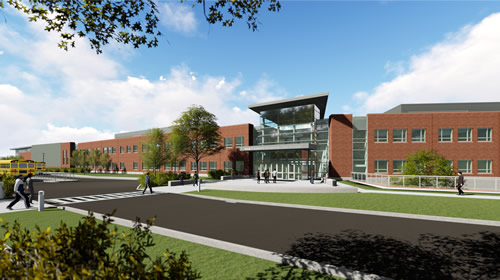
Ella T Grasso High School

Featured

  • Fayetteville State University Opens New Residence Hall

    Fayetteville State University (FSU) in Fayetteville, N.C., recently completed construction on a new $50-million residence hall, according to a news release. The university partnered with KWK/Jenkins • Peer Architects on the design of Bronco Pride Hall.

  • University of Southern Mississippi Starts Construction on Oyster Hatchery

    The University of Southern Mississippi (USM) recently announced that construction has begun on a new oyster hatchery at its Gulf Coast Research Laboratory (GCRL) Thad Cochran Marine Aquaculture Center (TCMAC) Cedar Point campus in Ocean Springs, Miss., according to a news release.

  • North Texas School District Completes Third New Elementary School

    The Denton Independent School District in Dallas, Texas, recently finished construction on its third prototype design elementary school, Reeves Elementary, according to a news release.

  • Image credit: O

    Strategic Campus Assessment: Moving Beyond Reactive Maintenance in Educational Facilities

    While campuses may appear stable on the surface, building systems naturally evolve over time, and proactive assessment can identify developing issues before they become expensive emergencies. The question isn't whether aging educational facilities need attention. It's how institutions can transition from costly reactive maintenance to strategic asset management in a way that protects both budgets and communities.

Digital Edition