Riverside Community College District (RCCD): RCCD Coil School of the Arts
Riverside Community College District

PHOTOS COURTESY OF LPA INC./COSTEA PHOTOGRAPHY, INC.

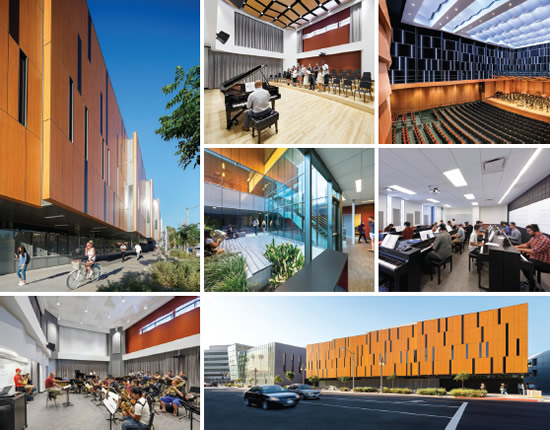
The Centennial Plaza in Riverside, CA, designed by LPA, Inc., is a project that serves a dual purpose—to provide space for instruction and to bring the community downtown to enjoy the arts. The centerpiece of the block is the LEED Gold-certified, 36,000-square-foot Coil School of the Arts. The design includes a 450-seat music concert hall, classrooms, practice rooms, a choral room, band room, orchestra room, a piano lab, and a state-of-the-art recording studio.

Designed with acoustics as a priority, the Coil School for the Arts is the home of the renowned Riverside City College Music Department. The concert hall concept design mirrors as a musical instrument, featuring deployable wall panels, mechanized perimeter drapery, and a moveable stage cloud that can be configured to support any music genre.

The architecture expresses the nature of the building, using heavy concrete masonry for its acoustical mass properties as the main building material. On the main façade, a large cantilever provides shaded spaces for outdoor visitors and users. Glass at the lower level creates a connection of the indoor activity of people in the lobby while patterned wood laminate panels resemble the craft of wood-made musical instruments.

The district’s commitment to the arts, culture, and history through the vision of the Centennial Plaza will solidify downtown Riverside’s place as an urban center for activity, creativity, and lifelong learning.

This article originally appeared in the College Planning & Management April 2018 issue of Spaces4Learning.

Featured

  • TCU Marks Campus Expansion Milestone

    Texas Christian University in Fort Worth, Texas, recently held a topping-out ceremony to mark progress on a major campus expansion effort including four new residential facilities and a five-story parking garage, according to a news release.

  • Rethinking K-12 Schools as a Continuous Learning Experience

    Most students move through three or more separate facilities during their K-12 journey, yet the built environments they encounter at each stage have traditionally been designed in isolation, with little continuity in spatial language, learning philosophy, or physical resources. Each new school is a reset with different layouts, learning models, expectations, and ways of moving through a building. The next generation of school design is making the case that the first day of kindergarten and the last day of high school can and should feel connected through common support systems and infrastructure in the physical environment.

  • Q&A: How to Prevent Kitchen Grease Fires in Commercial Kitchens

    School cafeterias and university dining halls serve thousands of meals daily, relying on high-heat equipment like fryers, grills, and ovens. While these operations keep students fed, they also generate significant grease-laden vapors. Without proper controls, this grease becomes a silent fire threat. As a certified exhaust cleaning specialist and business coach who has helped hundreds of institutional facilities achieve NFPA 96 compliance, I emphasize that proactive grease management isn’t optional; it’s a core fire/life safety practice.

  • Designing Third Spaces That Do What AI Can't

    In 2026, education is evolving faster than ever. With AI reshaping everything from lesson planning to personalized instruction, schools and universities are turning their attention to what AI can’t replicate: spaces that foster collaboration, community, and creativity.