Reducing Runoff, Growing Student Spaces
Unilock Pavers

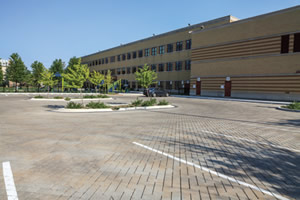
Orozco Academy in Chicago was able to reduce the possibility of future flooding, while also giving students more space for recreation—all with the help of Unilock Pavers.

Orozco Academy in Chicago, Ill., is a fine arts and sciences elementary school dedicated to fostering student engagement and creativity. The Academy has been transformed with the help of Space to Grow, an innovative public-private partnership program that develops Chicago schoolyards into centers for school and community life to support active healthy lifestyles, outdoor learning, physical education, and engagement with nature.

The City Department of Water Management and the Metropolitan Water Reclamation District are funded to reduce flooding and combined sewer overflows but often have no available land to temporarily store runoff. The Chicago Public Schools have land but limited budgets, which are typically targeted to classrooms and teachers rather than playgrounds and parking lots.

The Space to Grow program partners these groups for mutual benefit. The stormwater management improvements at Orozco include 10,000 square feet of Unilock Eco-Optiloc permeable pavers and have the capacity to hold more than 303,000 gallons of water. Additional site improvements include: a multipurpose turf field, play equipment for younger and older students, an outdoor classroom area, a rain garden with native plants, and seating throughout the schoolyard.

Students now have a much-needed play space while runoff rates and volumes are significantly reduced eliminating the likelihood of future flooding and greatly reducing the pollutant load to local waterways.

www.unilock.com

This article originally appeared in the School Planning & Management May 2018 issue of Spaces4Learning.

Featured

  • Florida District Completes Construction on New Leadership Institute

    Pinellas County Schools near Tampa, Fla., recently announced that construction is complete on the new Dr. Michael A. Grego Leadership Institute, according to a news release. The district partnered with Rowe Architects for the project’s design and with Skanska for construction services.

  • Designing for Every Mind

    Learning environments have the power to shape not just what students know, but who they become. When a school is designed with genuine empathy—for the full range of ways students think, sense, and engage with the world—it becomes more than a building. It becomes a catalyst for growth, confidence, and belonging. That is the animating idea behind neurodiverse design, and it is one that is transforming how more architects and designers are thinking about school design.

  • Architectural Power for the Modern Campus Landscape

    For generations, an outdoor classroom only required a textbook and a patch of grass. Today, not only has the laptop replaced the printed pages, the rise of agile learning has turned campuses into study halls with students listening to lectures and researching topics from quads, gardens, and plazas. The challenge for architects and facility managers is to provide connectivity without cluttering the landscape with visual eyesores or creating safety hazards with extension cords.

  • Moline-Coal Valley School District to Consolidate Two Schools into New Facility

    The Moline-Coal Valley School District in Moline, Ill., recently broke ground on a new elementary school that will consolidate the students and staff from two existing schools, according to local news. Robert Ontiveros Elementary School will serve as the new home for Lincoln-Irving Elementary School and Willard Elementary School.