New Science Center Planned at Bates College

Bates College in Lewiston, ME, recently announced a 2019 groundbreaking for a new science facility that will be geared toward collaborative research. The proposed facility will be home to a wide range of scientific disciplines, including chemistry, biology, and neuroscience.
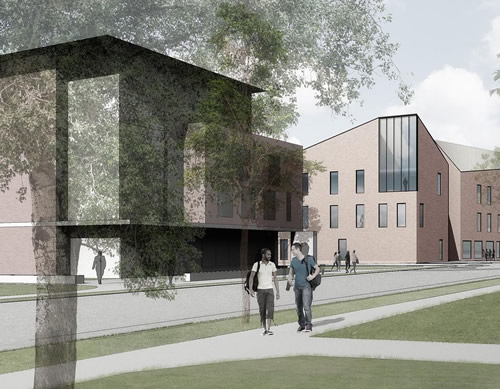
Bates College Science Building

By housing different science disciplines together, the new facility will aim to encourage a sharing of research and laboratory spaces in a way that promotes greater interaction among student researchers. The facility will be one of several elements that underline a growing emphasis on STEM at Bates in 2019. Architectural firm Payette is handling programming and design for the new facility, with Consigli Construction Co. undertaking construction management responsibilities. The project is scheduled for completion in 2021.

Featured

  • UT System Board of Regents Approves $108M Housing Complex

    The University of Texas System Board of Regents recently announced the approval of a new, $108-million housing complex at the University of Texas at El Paso (UTEP), according to a news release. The facility will stand four stories and have a total of 456 new beds for freshmen students.

  • Geometric abstract school illustration

    How Design Shapes Learning and Success

    Can the color of a wall, the curve of a chair, or the hum of fluorescent lights really affect how a student learns? More schools are beginning to think so.

  • University of Kansas Opens $400M Football Stadium Reconstruction

    The University of Kansas in Lawrence, Kan., recently announced that the $400-million reconstruction of David Booth Kansas Memorial Stadium is complete in time for the 2025 football season, according to a news release. The university partnered with Turner Construction Company on the project.

  • Different Starting Points, Same End Goal

    Higher education campuses can enhance student experience by implementing mobile credentials to streamline building access, on-campus payments, and access to other amenities. This enables students to connect to their campuses through the technology they use most: their mobile devices.

Digital Edition