Ground Breaking Celebrated for Connecticut High School

A ground breaking was held recently for a modernized New London High School in New London, Conn. The North Campus project is going to be home to students in grades 6 through 12 and will feature special facilities for STEM, visual and performing arts and foreign languages.
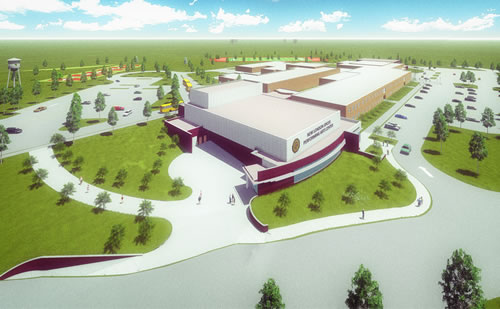
New London High School

The project will cost roughly $98 million and will begin with a complete reconstruction of the running track, which is on-track for an August completion. New construction on New London’s South Campus is expected to begin in 2019 following the completion of initial phases of the North Campus.

Featured

  • Illinois District Boosts Security at High-School Stadium

    Richmond-Burton Community High School in Richmond, Ill., recently announced that it has completed the redesigned entrance to its high school stadium with a new focus on school security and community engagement, according to a news release. The district partnered with Wold Architects and Engineers on the project as part of District #157’s year-long facilities master plan.

  • UNT Dallas Holds Ribbon-Cutting Ceremony for $100M STEM Building

    The University of North Texas at Dallas in Dallas, Texas, recently celebrated the opening of its new, $100-million STEM Building, according to local news. The ceremony on Dec. 2 preceded the first day of classes in the facility on Jan. 12, 2026.

  • North Carolina District Completes New Elementary School

    The Wake County Public School System (WCPSS) in Holly Springs, N.C., recently announced that construction on a new elementary school has finished, according to a news release. Rex Road Elementary School measures in at 133,000 square feet and is the fifteenth school that general contractor Balfour Beatty has completed for the district.

  • Image credit: O

    Strategic Campus Assessment: Moving Beyond Reactive Maintenance in Educational Facilities

    While campuses may appear stable on the surface, building systems naturally evolve over time, and proactive assessment can identify developing issues before they become expensive emergencies. The question isn't whether aging educational facilities need attention. It's how institutions can transition from costly reactive maintenance to strategic asset management in a way that protects both budgets and communities.

Digital Edition