Progress Made on Duke University Residence Halls
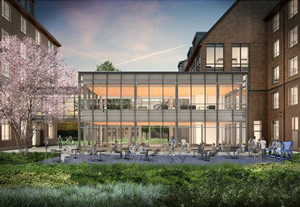
Duke University the HollowsDuke University in Durham, NC, recently celebrated the topping-out milestone for the new Hollows Residence Halls on the West Campus. The highest structural feature was placed on the residence halls, which consist of two adjacent six-story buildings.

Together, the Hollows will house approximately 500 students in suite-style living spaces. Along with multiple room configurations, they will also feature student lounges, kitchen spaces, study areas, and living quarters for resident advisors.

The Hollows are being constructed by Skanska USA, and have a projected completion date of sometime in 2019.

Featured

  • California School District Completes Elementary School Modernization

    The San Diego Unified School District in San Diego, Calif., recently held a ribbon-cutting for a whole-site modernization of Pacific Beach Elementary School, according to local news. The school first opened with one building in 1930 and added six more between 1938 and 1957.

  • Abstract tech network data connections with orange, blue glowing dots, lines

    3 Trends for Higher Education to Stay Ahead of in 2026

    As universities enter the new year, the question is no longer whether digital transformation is necessary, but how quickly institutions can convert technological potential into strategic advantage.

  • LAN, Inc. Opens Office in College Station, Texas

    Lockwood, Andrews & Newnam, Inc. (LAN) recently announced the opening of a new office in College Station, Texas, to support its regional client base, according to a news release. The organization provides engineering, design, and program management services for water, wastewater, transportation, stormwater, and education clients in the Brazos Valley.

  • Niles West High School Natatorium Renovation

    Natatoriums are highly specialized spaces, and luminaires in this setting face several unique challenges. Perhaps the most significant is corrosion, which is exacerbated by high indoor humidity, condensation, and pool chemicals, often resulting in material degradation in luminaires not certified to perform in corrosive environments.