Funding Provided for Arts Facility at Arkansas State University

Arkansas State University in Jonesboro (ASU) recently announced that the Windgate Foundation is to offer a $6.7 million grant to build a new facility for sculpture and ceramics programs at ASU, the largest single gift to an arts program in ASU’s history.
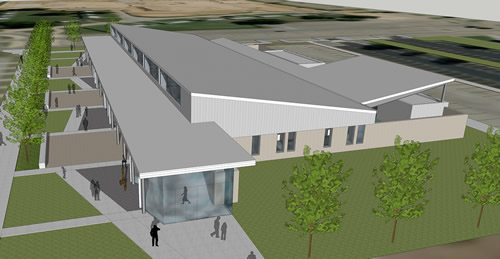
Arkansas State University Windgate Center for Three-Dimensional Arts

The proposal will fund the construction of a new facility—the Windgate Center for Three-Dimensional Arts—with studio and exhibition space for sculpture and ceramics, often referenced in the art world as the 3D arts. The new facility's studio and work areas are expected to cover approximately 20,000 square feet, almost four times the space available in ASU's Fine Arts Annex.

Featured

  • A digital silhouette works at a computer, immersed in a glowing, interconnected world

    How Will AI Transform Learning Space Design?

    For years, higher education has designed learning spaces around technology as a tool for display, capture, collaboration, and connectivity. AI changes that equation.

  • Stanford Online Reveals New Immersive Learning Studio

    Stanford Online recently marked its 30th anniversary with the announcement of a new immersive learning studio, according to a university news release. The studio takes advantage of AI-powered and immersive learning technologies to continue delivering personalized and faculty-led education.

  • Cal Poly Humboldt Starts Construction on Healthcare Education Hub

    California State Polytechnic University, Humboldt in Arcata, Calif., recently announced that work has begun on a renovation project that will turn the Stewart Building into a new Healthcare Education Hub, according to a news release. The university is partnering with Sundt Construction Inc. for construction services.

  • Designing for Every Mind

    Learning environments have the power to shape not just what students know, but who they become. When a school is designed with genuine empathy—for the full range of ways students think, sense, and engage with the world—it becomes more than a building. It becomes a catalyst for growth, confidence, and belonging. That is the animating idea behind neurodiverse design, and it is one that is transforming how more architects and designers are thinking about school design.