School's Innovation Lab Greeted With Success
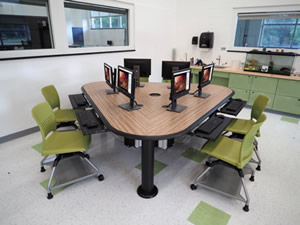
Chatham Middle School in New Jersey partnered with SMARTdesks to create collaborative learning spaces for their STEM Program.
It took some time to accomplish the STEM micro campus serving the 960 sixth, seventh, and eighth graders at New Jersey’s Chatham Middle School, Danielle Dagounis, supervisor of Instructional & Design Technology, will tell you. “Five years ago, we started our STEM Program, offering a wide array of programs. To get things started, we had to take over the computer lab. The one downfall of that is: it’s a computer lab,” she explains. “You didn’t have any supports to allow the students to collaborate.”
Dagounis continues, “The plan was to make a new STEM focus area with classrooms set up to serve different purposes. The classroom we are talking about today is what we call our Innovation Lab. The Innovation Lab is the room that features SMARTdesks collaboration furniture.”
Dagounis had a difficult time finding collaborative computer desks. “Apparently, if you want collaborative computer desks, they’re like unicorns,” she says. “I went to the New Jersey School Board Convention two or three years ago and saw some of SMARTdesks’ products being demonstrated in person. When I Googled ‘collaborative computer tables,’ SMARTdesks was the most relevant result. I got some measurements, gave them to my architect, and asked if these SMARTdesks collaboration tables would fit. And they did.”
“Yes, we had interface with the architect,” adds Jeffry Korber, SMARTdesks CEO. “They called us. We have our own design department, so we did a layout. That is one way we differentiate ourselves. I was directly involved in the engineering.”
“And that is good, because now we have an effective collaborative learning classroom,” Dagounis says. “It is important for our students to be able to collaborate with one another, and not just come in and work on their own without having to work with other people.”
www.smartdesks.com
This article originally appeared in the School Planning & Management March 2019 issue of Spaces4Learning.