Mobile Furniture Makes for Engaged Minds
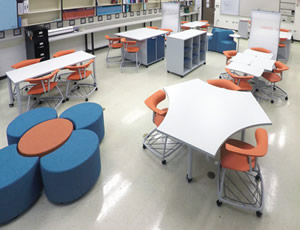
Buffalo Grove High School in Illinois was selected for KI’s Ruckus Grant Program to measure how furniture impacts student learning.
At Buffalo Grove High School in Illinois, collaborative learning is a pillar of the curriculum.
Teachers and students found that traditional classroom layouts obstructed their ability to integrate group work throughout the school day. “One [student] said they’d rather sit on the floor every day,” says Buffalo Grove teacher Maggie Sheehy. Students said it was a pain to move their chairs and belongings all the time, especially in smaller classrooms.
To address the problem, Buffalo Grove applied to become a test site for global furniture maker KI’s Ruckus Grant Program, a national project measuring how furniture impacts student learning.
One of nine schools selected for the program, Buffalo Grove partnered with KI’s education design experts to revamp its Education Pathway classroom, where students interested in teaching professions learn state-of-the-art pedagogies.
Following winter break, students found their traditional classroom had transformed into an open, flexible learning space with mobile chairs, stools, desks, and lounge furniture where students and teachers could seamlessly change how they sat, learned, and worked together.
The results were striking. After the classroom redesign, Buffalo Grove students reported a 55-percent increase in movement and a 39-percent increase in group work.
“The furniture allows for a lot more mobility and moving of tables into pods of two groups of three,” teacher Corinne Ginder says. “As soon as we got the new furniture, the number of students that I would’ve thought would sit next to each other formed different, collaborative groups.”
Students also reported a 23-percent increase in engagement and participation. Their enthusiasm was palpable.
www.ki.com
This article originally appeared in the School Planning & Management March 2019 issue of Spaces4Learning.