Virginia Commonwealth University College of Health Professions Opens

RICHMOND, VA – In 2019, to mark its 50th anniversary, Virginia Commonwealth University (VCU) has opened a new College of Health Professions building, designed by EYP Architecture & Engineering. Bringing all of the institution’s 11 units under one roof, from five different buildings across two campuses, will enable VCU students and faculty to collaborate in ways that have not been previously possible.
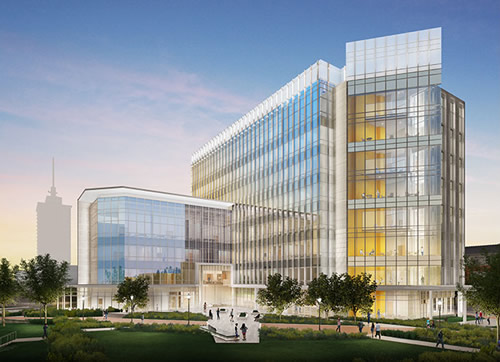
VCU Health Professions

Designed for LEED Silver certification, the $87.3 million College of Health Professions building will increase the capacity to grow VCU’s high-demand programs and promote a culture of interprofessional practice that mirrors the future of health care delivery.

The 154,000-square-foot building, which includes a west-facing eight-story wing and a south-facing four-story wing, is equipped with learning laboratories designed for patient simulation and diagnostic technology. Each of the eight floors features formal and informal spaces designed to promote interprofessional education and collaboration among the health professions specialties. Flexible classrooms have been designed for student engagement and distance-learning opportunities.

Featured

  • Hawaii Elementary School Reopens Following $25M Campus Modernization

    Haʻaheo Elementary School in Hilo, Hawaii, has reopened to students following a three-year, $25-million campus modernization and expansion project that significantly increases the school's instructional space while preserving one of the island's oldest educational institutions, according to local news.

  • Sam Houston State University Completes Athletic Stadium Renovations

    Sam Houston State University in Huntsville, Texas, recently announced the reopening of Elliott T. Bowers Stadium after an extensive renovation project, according to a news release. The university partnered with Stantec and DLR Group for the project’s design.

  • Rethinking K-12 Schools as a Continuous Learning Experience

    Most students move through three or more separate facilities during their K-12 journey, yet the built environments they encounter at each stage have traditionally been designed in isolation, with little continuity in spatial language, learning philosophy, or physical resources. Each new school is a reset with different layouts, learning models, expectations, and ways of moving through a building. The next generation of school design is making the case that the first day of kindergarten and the last day of high school can and should feel connected through common support systems and infrastructure in the physical environment.

  • ed tech conference calendar

    Upcoming Awards, Events & Webinars