The College of the Holy Cross: Hart Center Expansion
The College of the Holy Cross

IMAGES COURTESY OF SASAKI

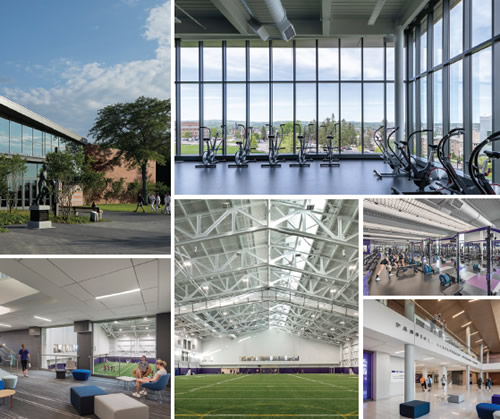
The phased expansion of the Hart Athletic Center at the top of Mount Saint James on the campus of the College of the Holy Cross in Worcester, MA, was completed in December 2017. Eight distinct implementation phases allowed the college to maintain use of the building throughout construction.

The visible and transparent complex will provide a comprehensive complement of facilities, including strength and conditioning, sport medicine, and practice venues, aimed at improving performance, increasing awareness, and supporting all of the Crusaders’ Division 1 programs.

The college’s primary goal for the project was to elevate facilities for all programs to help recruiting and improve the development opportunities for student athletes.

The new 143,000-square-foot addition includes a 60-foot-high indoor turf practice facility, an auxiliary practice gymnasium, suites for basketball and administration offices, a dynamic strength and conditioning center, various meeting rooms, a new main entrance lobby, and new locker rooms, to ensure that all programs have dedicated team rooms.

The renovations will provide additional offices, a rowing studio, a new sport medicine suite, expanded accommodations for equipment handling, and a new locker room for the women’s ice hockey program, which is also now competing in Division 1.

The design, by Sasaki, completely transforms the original 1975 building, giving it a greater presence on campus and a renewed pride in the storied history of Holy Cross athletics.

This article originally appeared in the College Planning & Management June 2019 issue of Spaces4Learning.

Featured

  • TCU Marks Campus Expansion Milestone

    Texas Christian University in Fort Worth, Texas, recently held a topping-out ceremony to mark progress on a major campus expansion effort including four new residential facilities and a five-story parking garage, according to a news release.

  • Rethinking K-12 Schools as a Continuous Learning Experience

    Most students move through three or more separate facilities during their K-12 journey, yet the built environments they encounter at each stage have traditionally been designed in isolation, with little continuity in spatial language, learning philosophy, or physical resources. Each new school is a reset with different layouts, learning models, expectations, and ways of moving through a building. The next generation of school design is making the case that the first day of kindergarten and the last day of high school can and should feel connected through common support systems and infrastructure in the physical environment.

  • Q&A: How to Prevent Kitchen Grease Fires in Commercial Kitchens

    School cafeterias and university dining halls serve thousands of meals daily, relying on high-heat equipment like fryers, grills, and ovens. While these operations keep students fed, they also generate significant grease-laden vapors. Without proper controls, this grease becomes a silent fire threat. As a certified exhaust cleaning specialist and business coach who has helped hundreds of institutional facilities achieve NFPA 96 compliance, I emphasize that proactive grease management isn’t optional; it’s a core fire/life safety practice.

  • Designing Third Spaces That Do What AI Can't

    In 2026, education is evolving faster than ever. With AI reshaping everything from lesson planning to personalized instruction, schools and universities are turning their attention to what AI can’t replicate: spaces that foster collaboration, community, and creativity.