Delivering Around-the-Clock Power
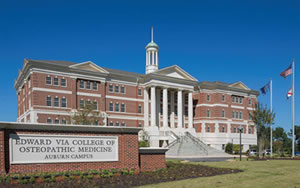
To ensure the power is always on, the Edward Via College
of Osteopathic Medicine installed a Cat G3412 gas generator
to back up the utility feed at the Auburn, AL, campus.
On a branch campus
of Virginia Tech in Auburn,
AL, the Edward Via College of
Osteopathic Medicine (VCOM) opened its
doors with a vision to provide healthcare
for nearby underserved regions while
promoting biomedical research. In a
state-of-the-art building on the southern
end of the Auburn campus, more than 325
VCOM first-and second-year students are
taught the fundamentals of osteopathic
medicine. VCOM’s curriculum is based on
a digital platform so continuous power is
critical.
To ensure uninterrupted power, VCOM
installed a Cat G3412 gas generator to back
up the utility feed at their Auburn campus
when the building first opened. Based on a
recommendation from Cat dealer Thompson
Tractor, VCOM transfers the electrical
load to the facility once a month.
“Every time, the generator has kicked
right in and done what it’s supposed to do,”
says Randy Cerovsky, facilities director for
VCOM-Auburn. “We have never noticed
any delay in the amount of time it takes for
the generator to start up and transfer the
power over. Everything just runs smoothly;
we’ve never had any issues.”
Technicians from Thompson Power
Systems perform regular maintenance
on the generator set. “Thompson Power
Systems has been great to work with,”
Cerovsky says. “They do all of the service,
and they explain everything.”
Cerovsky receives email alerts when
the generator runs or if issues arise. “One
of the features I like is the Cat Connect
interface that enables us to receive
SMTP alerts so if anything’s wrong, we
get notified and call to receive service
immediately.”
www.cat.com/en_US
This article originally appeared in the College Planning & Management September 2019 issue of Spaces4Learning.