Gemini Middle School Reveal New Changes, Continues Construction

Gemini Middle School, outside of Chicago, debuted several changes as they began this school year. Formerly known as Gemini Junior High, the school unveiled new renovations as they welcomed their doors to more than 1,000 students from 6th to 8th grade.

The new student commons at Gemini Middle School is filled with natural light.

The expansion and remodeling cost $33 million and is expected to be fully completed by the end of the year. The middle school renovations were designed by DLA Architects.

“We’re really excited about the new spaces that we have created that are going to provide fun, exciting and collaborative learning opportunities for students,” Principal Lewis Roberts told the Chicago Tribune.

“We’ve also spent a lot of time thinking about how students learn...the 21st century learner, and what students are going to need to prepare them not only for high school, but for life skills.”
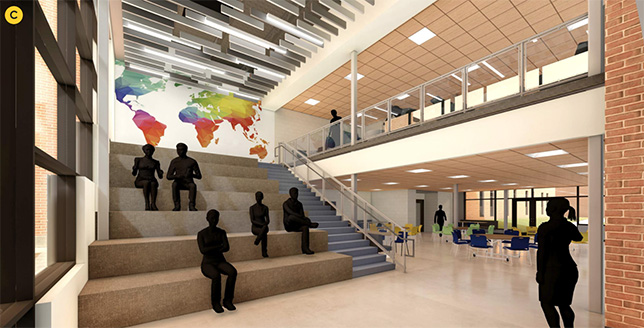
Gemini Middle School, outside of Chicago, debuted several changes as they began this school year including an expanded cafeteria with learning stairs.

Features of the school include:

  • A new fitness center;
  • An expanded cafeteria with learning stairs;
  • An instrumental music suite;
  • An interior courtyard;
  • An auxiliary multi-purpose room with a stage; and
  • Kitchens for home economics.

The entrance will have the school mascot, along with blue and gold school colors, on the windows. The new student commons is filled with natural light. There are more writable surfaces located throughout the school to encourage expression and learning. In addition, there are numerous plugs to charge student-issued Chromebooks.

Upgrades to the middle school began when East Maine School District 63’s launched their master plan in December 2016. More than 100,000 square feet of space was part of the upgrades.


About the Author

Yvonne Marquez is senior editor of Spaces4Learning. She can be reached at [email protected].

Featured

  • Q&A: How to Prevent Kitchen Grease Fires in Commercial Kitchens

    School cafeterias and university dining halls serve thousands of meals daily, relying on high-heat equipment like fryers, grills, and ovens. While these operations keep students fed, they also generate significant grease-laden vapors. Without proper controls, this grease becomes a silent fire threat. As a certified exhaust cleaning specialist and business coach who has helped hundreds of institutional facilities achieve NFPA 96 compliance, I emphasize that proactive grease management isn’t optional; it’s a core fire/life safety practice.

  • Texas A&M Opens First Building at Fort Worth Campus, Breaks Ground on Research Facility

    The Texas A&M University System marked a major milestone in the development of its Fort Worth campus by opening its first completed academic building and breaking ground on a second facility designed to expand research and industry collaboration.

  • Planning with Clarity: Using AI to Make Better Campus Decisions, Not Just Better Designs

    Higher education leaders are being asked to make increasingly high-stakes decisions about campus facilities amid greater uncertainty than ever before. Social and economic pressures, shifting enrollment, and evolving learning models compete with growing deferred maintenance needs to strain even the most robust infrastructure budgets.

  • CU-Lock Haven Receives $1.75M Gift for New Entrepreneurship, Media Center

    Commonwealth University-Lock Haven in Lock Haven, Penn., recently received a $1.75-million donation from entrepreneur and alumnus Nicholas Subich ’17, according to a university news release. The funds will go toward establishing the Nicholas Subich Center for Entrepreneurship and Media, a technology-driven hub for innovation and experiential learning.