Concordia University-Portland Opens Nursing Innovation Center
PORTLAND, OR – In its preparation of nurses to serve the increasing health care needs of the Pacific Northwest and beyond, Concordia University-Portland expanded its nursing degree offerings and opened a new Nursing Innovation Center at its Columbia River Campus.
The addition of an eastside Nursing Innovation Center at Concordia’s Columbia River Campus in Portland, OR, provides 41,000 square feet of additional nursing clinical and classroom space, in addition to the 12,000 square feet westside Concordia Nursing Skills Center, which opened in Spring 2017.
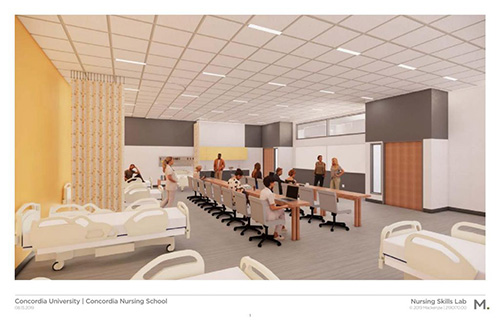
“We’re excited to build upon the success of Concordia University’s nursing program, serving students at both Eastside and Westside locations,” shared Julie Dodge, dean of Concordia University-Portland’s College of Health & Human Sciences. “Concordia nurses receive the clinical and community experience to become highly skilled and caring professionals.”
“We now offer the full spectrum of options for anyone considering nursing,” says Lisa Presnall, Concordia University-Portland’s Associate Dean of Nursing. “From pre-nursing, to an accelerated bachelor degrees in nursing, to hybrid online and traditional programs, Concordia is meeting students where they are.”
In the past year, Oregon’s State Board of Nursing approved significantly expanded capacity for Concordia’s Accelerated Bachelor of Science in Nursing (ABSN) program, supported by Orbis Education. Concordia’s recent nursing graduates passed the May 2018 NCLEX-RN nursing exam at a rate of 100 percent. Concordia’s ABSN program fast tracks students who have completed their general education requirements and nursing pre-requisites into the nursing profession. It delivers a high-quality, clinically intensive nursing education in a short amount of time through a blend of online learning, practical application in a simulation lab, and in-hospital clinical rotations at top healthcare facilities throughout the Portland area.
To learn more visit accleratednursing.cu-portland.edu or call 866/892-5321.
About Concordia University
Concordia University-Portland is Oregon’s largest private, nonprofit university. Located in northeast Portland, Concordia is a Lutheran liberal arts university with a mission of preparing leaders for the transformation of society. Founded in 1905, Concordia Portland serves approximately 5,000 students on its campuses and online, through its College of Education, College of Health & Human Sciences, School of Management, and Concordia University School of Law in Boise, ID. For more about Concordia University, visit www.cu-portland.edu and www.concordialaw.com.