Florida Tech to Build $18M Health Sciences Research Center

MELBOURNE, FL – Florida Institute of Technology will break ground in spring 2020 on a 61,000-square-foot Health Sciences Research Center that will help fill the growing demand for jobs in the biomedical and premedical science fields and allow students and faculty to conduct critical research in labs equipped with the latest cutting-edge technologies, from virtual-dissection tables to atomic force microscopes.

The new, $18 million facility will double the size of Florida Tech’s undergraduate biomedical engineering program to 300 full-time, on-campus students; increase the size of the undergraduate premedical program from 150 to 250 students; provide over 20,000 square feet of classroom and training spaces; and allow students access to teaching laboratories that use augmented and virtual reality tools and space for orthopedics, tissue studies and advanced computational simulations.
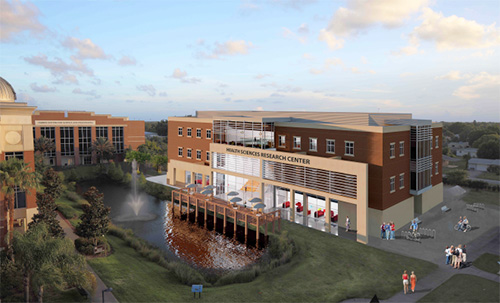
Florida Tech Health Sciences Center 500

The Center will be built on a vacant parcel of land on the south campus area known as the Olin Quad. It will be south of the Olin Life Sciences Building and adjacent to the quad’s newest buildings, the Harris Center for Assured Information, which opened in 2009.

The Center will be funded by the sale of Educational Facilities Revenue Bonds.

Featured

  • LAN, Inc. Opens Office in College Station, Texas

    Lockwood, Andrews & Newnam, Inc. (LAN) recently announced the opening of a new office in College Station, Texas, to support its regional client base, according to a news release. The organization provides engineering, design, and program management services for water, wastewater, transportation, stormwater, and education clients in the Brazos Valley.

  • Kimball International Releases Curated Design Support Program

    Commercial furnishings company Kimball International recently announced the launch of a new end-to-end design support program, DesignSuite. According to a news release, its goal is to guide architecture & design professionals and dealer partners through the process from vision to specification.

  • Geometric abstract school illustration

    How Design Shapes Learning and Success

    Can the color of a wall, the curve of a chair, or the hum of fluorescent lights really affect how a student learns? More schools are beginning to think so.

  • Pitzer College

    Designing for Change in Higher Ed Learning Environments

    Higher education will continue to evolve, and learning environments must evolve with it. By prioritizing adaptable infrastructure, thoughtful reuse, strong energy performance, and wellness-centered design, campuses can create spaces that support learning today while remaining flexible for the future.