TAMU Plant Pathology and Microbiology Building Opens

COLLEGE STATION, TX – An initiative begun during the 2012-2013 academic year led Texas A&M University’s (TAMU) College of Agriculture and Life Sciences to declare five grand challenges of agriculture. Three of those—“Feeding Our World,” “Improving Our Health,” and “Protecting Our Environment”—were specifically called out by Sandy Pierson, professor and head of the Department of Plant Pathology and Microbiology, during the groundbreaking ceremony for the Plant Pathology and Microbiology Building two years ago. Now, with the building’s official grand opening in late October, the department can enhance its collaborative efforts with the Institute for Plant Genomics and Biotechnology (IPGB) and other College of Agriculture and Life Sciences departments, including Entomology, Horticulture, Soil and Crop Sciences, Biochemistry and Biophysics, Ecosystem Sciences and Management, and Wildlife and Fishery Sciences.
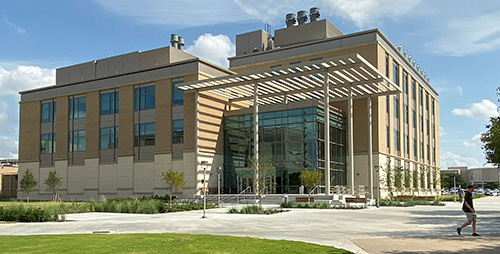
Texas A&M Plant Pathology 200

The new building provides generic, flexible labs with the capabilities necessary to support research as it evolves. Its 84,000 square feet includes two plant pathology instructional labs, one bio-environmental instructional lab, teaching support spaces, 20 general research spaces with associated support areas, an integral greenhouse, two multipurpose seminar rooms, one multipurpose flat-floor auditorium, and administrative offices. Its placement adjacent to the Horticulture/Forest Science Building, and near other related research departments and facilities, strengthens and enhances opportunities for cross-disciplinary collaboration among faculty and students.

The building, which will serve as the new home of the Department of Plant Pathology and Microbiology as well as the Bioenvironmental Sciences (BESC) program, was planned and designed by Flad Architects in collaboration with architect of record Randall Scott Architects.

Featured

  • Pudu Robotics Launches AI-Powered, Large-Scale Floor Sweeper

    Pudu Robotics recently launched the newest member of its MT1 series of robotic floor sweepers, the PUDU MT1 Max, according to a news release. The AI-powered, 3D perception robotic sweeper was designed for use in large, complex cleaning environments both indoors and semi-outdoors, like parking garages and semi-open building atriums.

  • Creating Long-Term Sustainability on College Campuses Through Fair Student Housing

    The quality of student housing can have a significant impact on an individual’s college experience. Today’s higher education institutions face mounting challenges, including declining enrollment, low retention rates between the first and second years, and a rise in student mental health concerns. Thoughtfully designed living spaces can help address these issues by creating environments that promote both academic focus and personal well-being.

  • Los Angeles City College Breaks Ground on New Administration, Workforce Building

    Los Angeles City College (LACC) in Los Angeles, Calif., recently broke ground on a new $72-million administrative facility, according to a news release. The Cesar Chavez Administration and Workforce Building will stand four stories, cover 67,230 square feet, and play home to a wide variety of the school’s educational and administrative services.

  • textured paper collage shows a school building on fire as a fire truck sprays water into the flames

    Why a Fire Loss Is More than Flames

    We've all seen what fire damage can do to a property, but the types of damage building owners often encounter after a fire loss can exceed expectations. Having full awareness of the different forms of damage properties can sustain helps owners respond faster, reduce continued damage, and get back on the road to recovery in short order.

Digital Edition