Orange Coast College Language Arts and Social Science Building Breaks Ground

COSTA MESA, CA – A recent groundbreaking took place for Orange Coast College’s (OCC) new $50-million Language Arts and Social Science Building. The three-story, 107,760-square-foot building is part of a larger initiative to modernize the campus and accommodate its rapidly expanding enrollment. It is expected to be complete in summer 2021.
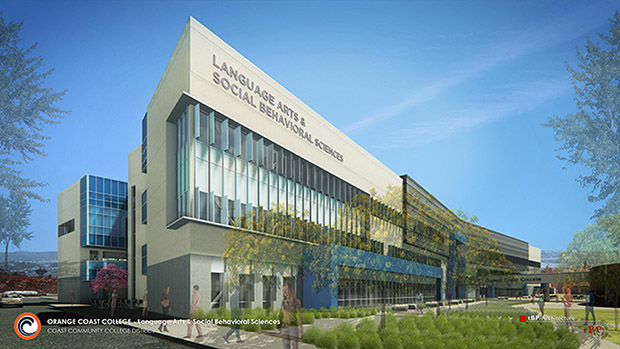
Orange Coast College Language Arts Building

The Language Arts and Social Science Building’s first floor will house classrooms, labs, an English as a Second Language (ESL) computer lab and room, facilities for the Speech, Debate and Theater Team and a journalism newsroom. The second floor will be comprised of classrooms and connect to the existing Mathematics Business and Computer Center Building, while the third floor will encompass division and faculty offices. The building also will feature two elevators, a lactation room and gender-neutral restrooms on every floor.

The building is financed through a combination of funding from California Proposition 51 and Measure M, a $698-million general obligation bond provided to construct education facilities for Coast Community College District.

C.W. Driver is partnering with tBP Architecture on the project.

Featured

  • Virginia Tech Tops Out New College of Engineering Building

    Virginia Tech in Blacksburg, Va., recently celebrated the topping out of Mitchell Hall, which will soon stand as the largest College of Engineering building on campus, according to a news release. The university partnered with Skanska on the 285,500-square-foot facility, which has an expected completion date of winter 2028.

  • Montclair State University Starts Construction on $120M STEM Building

    Montclair State University in Montclair, N.J., recently broke ground on a new $120-million Interdisciplinary Science Building, according to university news. The university partnered with HoK Architects for the project’s design, and it’s scheduled to open in time for the 2028–29 academic year.

  • Rethinking K-12 Schools as a Continuous Learning Experience

    Most students move through three or more separate facilities during their K-12 journey, yet the built environments they encounter at each stage have traditionally been designed in isolation, with little continuity in spatial language, learning philosophy, or physical resources. Each new school is a reset with different layouts, learning models, expectations, and ways of moving through a building. The next generation of school design is making the case that the first day of kindergarten and the last day of high school can and should feel connected through common support systems and infrastructure in the physical environment.

  • Minnesota District Converts Middle School into Community Hub

    White Bear Lake Area Schools in White Bear Lake, Minn., recently announced the end of a major renovation project that converted a former middle school into a new centralized district and community hub, according to a news release.